
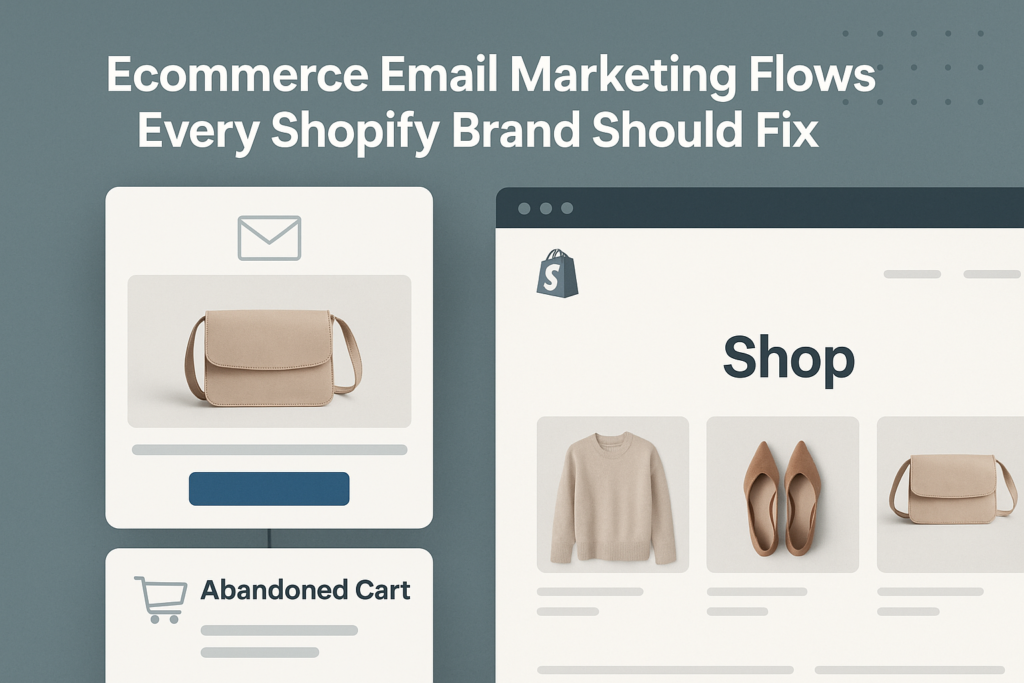
Ecommerce Email Marketing Flows Shopify Brands Can’t Ignore
Most Shopify brands automate email flows—few optimize them for actual revenue impact. As ecommerce grows more competitive, the gap between set-and-forget email automation and strategic lifecycle flows is widening. If you’re relying on default sequences, you’re almost certainly missing out on repeat customers, greater cart recovery, and higher lifetime value (LTV). This article breaks down the most important ecommerce email marketing flows, why they matter, and how to approach them for measurable business growth—not just inbox noise.
Why Most Shopify Email Flows Underperform
For many brands, launching automation is the finish line rather than the starting point. Nearly every Shopify store has some flavor of abandoned cart and order confirmation flows. But too many flows lack customer-centric triggers, relevance, or ongoing optimization. The result: open rates plateau, click rates decline, and crucial re-engagement opportunities vanish.
Here’s the business reality: today’s buyers expect timely, personal, and value-driven messages. Batch-and-blast campaigns or templated flows can’t deliver that. Underperforming email sequences fail to address:
- Why the customer abandoned their cart—price, doubt, distraction?
- What post-purchase assurance or education supports retention?
- How and when to re-engage lapsed buyers with relevance?
Success in ecommerce email marketing depends on mapping flows to real buyer behaviors—and iteratively optimizing the experience at every touchpoint.
The Critical Flows: Where to Audit First
With finite resources, where should a Shopify brand focus first to drive the most revenue impact? The answer is with flows closest to critical actions: cart recovery, first purchase, and repeat buying. At D2C Design, we start every retention engagement by auditing these core flows:
- Abandoned Cart Flows: Not all abandoned carts are the same. Segment by product category, customer value, or onsite activity. Test message timing, incentive structure, and personalized product reminders.
- Post-purchase Sequences: This is your moment to reinforce brand value, prevent buyer’s remorse, cross-sell, and set up the next purchase. Flows should adjust for product type, order value, and customer lifecycle stage.
- Winback/Re-engagement Automations: Bring back high-potential but dormant customers. Behavioral triggers—for example, segmenting based on past purchase frequency or category—outperform generic “we miss you” blasts every time.
To identify which flows need attention, measure:
- Open and click rates by segment and flow
- AOV (Average Order Value) attributed to each flow
- Repurchase rate after post-purchase series
- Time to next purchase
Audit weak points by analyzing which product categories see higher abandonment, or where particular customer segments drop off. Connecting the dots between flow performance and your merchandise mix is essential for scalable growth.
Need a sharper retention strategy or deeper insight? Learn more about working with an ecommerce retention marketing partner focused on measurable outcomes.
A Practical Framework: The Flow Optimization Lens
When reviewing your existing Shopify email campaigns, use this three-part lens:
- Behavioral Triggers: Are your flows activated by meaningful customer actions—not simply time-based?
- Personalization Depth: Are messages personalized by product, segment, and buyer journey, or are they generic and easily ignored?
- Testing & Measurement: Do you continuously A/B test subject lines, content, send times, and incentives for real improvements?
Flows are only as strong as your willingness to optimize. Too many brands let “good enough” stand, leaving LTV potential on the table.
Unlocking Higher LTV With Smarter Automation
High-growth brands go beyond basic email triggers. Today’s strategic ecommerce email marketing strategy fuses email with SMS, content, and real-time segmentation. For example, pairing abandoned cart emails with an SMS nudge can boost conversion for high-intent audiences.
Content matters just as much as timing. Post-purchase flows shouldn’t just confirm orders—they should activate product education, invite loyalty program sign-ups, and introduce relevant cross-sells tailored to what the customer actually bought. These micro-strategies build trust, reduce support tickets, and plant the seed for repeat business.
To elevate the experience, integrate your Shopify email campaigns with strategic content marketing and ecommerce SMS marketing. Message consistency and story-driven journeys improve open rates, click rates, and customer perceptions of your brand at every stage.
Measurement and iteration remain critical. Detailed reporting on flow performance (segmented by device, geography, and customer type) should inform your next round of optimization. Persistent testing outperforms hunches every single time.
Final Thoughts
The difference between brands that plateau and those with compounding retention growth? Attention to detail in their email flows. A conversion-first lens—auditing, optimizing, and tailoring each step—unlocks incremental revenue many Shopify brands leave untapped. Most importantly, it future-proofs your retention marketing as channels become more crowded and buyers more selective.
Ready to see which flows are holding back your growth? Start with a targeted Free Audit to benchmark, uncover hidden opportunities, and put your ecommerce email marketing on a path to stronger LTV.
Common Questions
What are the most important ecommerce email flows for Shopify stores to prioritize?
Focus on abandoned cart recovery, post-purchase sequences, and winback campaigns. These flows are closest to direct revenue and repeat business. Each should be tailored to your buyer segments and core product offers for highest impact.
How can I tell if my current Shopify email marketing strategy is underperforming?
Look for stagnating open and click rates, low conversion from abandonment flows, and minimal engagement in winback campaigns. Compare flow performance against industry benchmarks and analyze which customer segments aren’t responding. An external audit can quickly surface blind spots.
How do abandoned cart and winback flows boost ecommerce conversion and retention?
Abandoned cart flows recapture lost sales by addressing hesitation—or simply reminding distracted shoppers to finish checkout. Winback flows re-activate lapsed buyers, often with timely offers or reminders based on past behaviors, driving incremental revenue from your existing list.
Where does ecommerce SMS marketing fit into my retention strategy?
SMS complements email by providing instant, direct communication—especially for high-intent actions like cart recovery and limited-time offers. When integrated smartly with your email flows and customer segmentation, SMS boosts engagement and increases conversion across channels.