
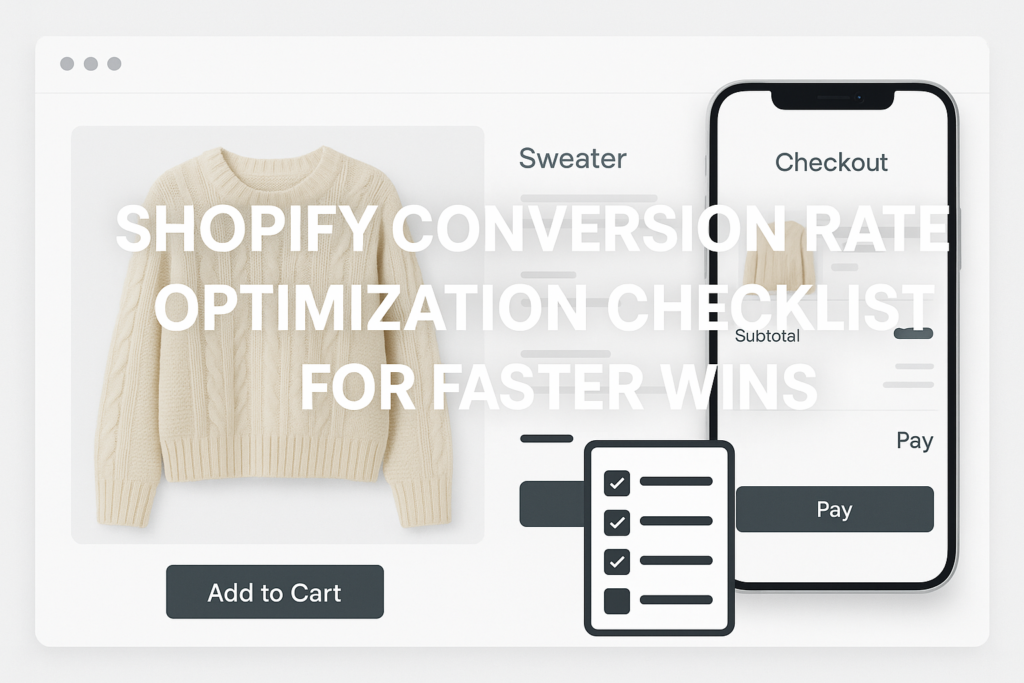
Shopify Conversion Rate Optimization Checklist for 2024
Every lost cart or stalled checkout drains revenue. If you manage an ecommerce brand on Shopify, you know that small friction points add up—eating into growth and margin with each abandoned session. Shopify conversion rate optimization is not just a technical exercise; it’s a core business function directly tied to ROI, customer acquisition costs, and competitive advantage. The real cost of leaving CRO unchecked? Lost sales, underperforming ad spend, and slower revenue cycles—all of which you can control with the right approach.
The Real Cost of Neglected Shopify CRO
Most high-traffic brands on Shopify invest heavily in paid acquisition and merchandising, but still fall short of their conversion potential. Why? Because CRO isn’t just about fixing “broken” elements—it’s about preventing revenue leaks caused by overlooked micro-barriers. Common offenders include:
- Poor product storytelling and non-actionable CTAs
- Generic or stale trust signals
- Slow load times on mobile, impacting both UX and SEO
- Hidden or confusing shipping and return policies
- Cluttered carts and multi-step, high-friction checkouts
Even the best-designed ecommerce stores are losing out if these areas aren’t addressed as part of a focused Shopify conversion rate optimization roadmap. Every step of your user journey should be engineered to remove doubt, build trust, and speed the buyer toward completion.
The Essential Shopify Conversion Rate Optimization Checklist
Effective CRO on Shopify is about prioritizing effort where it drives revenue fastest. Below, we offer a framework that our team uses to help brands achieve measurable improvement. Use this checklist to spot and close gaps in your own experience:
-
Product Pages: The Decision Point
- Clear, urgent and benefit-driven CTAs
- High-resolution images and mobile-optimized galleries
- Concise, scan-friendly product descriptions highlighting USPs
- Genuine customer reviews and ratings (with images if possible)
- Visible inventory and shipping timelines (activate urgency without resorting to tricks)
- Cross-sell and upsell recommendations based on buyer intent
-
Cart & Trust Signals: Reduce Exit Points
- Prominent security seals and payment options
- Guest checkout enabled by default
- Dynamic shipping estimates in-cart—no surprises
- Minimal distractions: Remove unnecessary upsells and pop-ups at this stage
- One-click cart editing (especially for mobile users)
-
Speed & Checkout: Remove All Friction
- Page speed scores above 80 for mobile and desktop
- Reduce checkout steps—ideally, use Shopify’s one-page checkout if possible
- Autofill fields for returning users and address info
- Never require account creation before purchase completion
- Show real-time order and payment confirmation
Each of these elements is essential for high converting ecommerce pages. The more precise and actionable your improvements, the higher your gain from every source of traffic.
Auditing for High-Impact Wins—What to Prioritize First
Not every improvement will move the needle equally—and time spent on low-impact tweaks is opportunity lost. Evaluate your Shopify store with three proven lenses:
- Analytics Drop-off Points: Use Google Analytics or Shopify’s built-in analytics to identify where users are abandoning sessions. Is it on product pages (information gap), cart (trust issue), or checkout (friction)? Start where loss is highest.
- Mobile vs. Desktop Experience: Check page speed, image scaling, and form inputs on real devices—not simulators. Mobile traffic dominates ecommerce, but mobile CRO remains under-invested.
- Visitor Questions & Objections: Gather evidence from customer support, chat logs, and on-site surveys to map what’s missing or unclear at each major journey stage.
The brands that see real uplift from ecommerce conversion optimization are those who regularly audit, prioritize, and iterate based on proven revenue impact. Leveraging a systematic Shopify website audit can speed this process, especially for teams with limited in-house CRO capacity.
Framework: The High-Impact CRO Prioritization Lens
Use this decision lens to allocate your resources for ecommerce landing page optimization:
- Quick Wins: Easy to implement, high conversion impact: e.g., add trust signals, streamline visual hierarchy, clarify shipping info.
- Revenue Boosters: Require more effort, but proven to drive AOV or repeat purchases: e.g., post-purchase email flows, optimized bundle options, smart upsells.
- Strategic Fixes: Deeper investments that solve legacy or technical bottlenecks: e.g., sitewide speed upgrades, full checkout redesign, enhanced mobile navigation.
Revisit this lens quarterly. Track your changes against conversion rates, AOV, and real customer feedback.
Final Thoughts
Conversion rate optimization on Shopify is a discipline—one that rewards rigor and agility. Prioritize the highest-leverage improvements first: as soon as you reduce friction and clarify value, sales velocity improves. Brands that commit to ongoing CRO unlock compounding performance gains and stand out in crowded categories. In 2024, small gaps in trust, speed, or UX aren’t minor—they’re missed revenue.
Want to accelerate results? Use a partner that understands the nuances of Shopify CRO from strategy to execution.
Ready to Identify Your Fastest CRO Wins?
Book a Free Shopify CRO Audit and let D2C Design map hidden conversion barriers in your store, benchmark you against high-performing brands, and deliver a revenue-focused action plan—no guesswork needed.
Common Questions
What is Shopify conversion rate optimization, and why does it matter?
Shopify conversion rate optimization is the systematic process of improving your store’s site design, product pages, trust signals, and checkout flow to maximize the percentage of visitors who become customers. It matters because incremental improvements compound into significant revenue gains and improved marketing ROI.
Which Shopify pages have the most impact on conversion rates?
Product pages and the checkout process have the greatest impact on conversion rates. High converting ecommerce pages combine compelling product detail, strong trust messaging, and minimal purchase friction. Optimizing these areas captures more value from your existing traffic.
How can I tell if my Shopify checkout flow is the problem?
Check your analytics for high exit rates during checkout, compare your mobile and desktop abandonment rates, and gather customer feedback on checkout pain points. If your flow requires excessive steps, account creation, or lacks clarity on shipping/costs, it’s likely hurting conversion.
What does a Shopify CRO audit from D2C Design include?
A Shopify CRO audit from D2C Design includes a comprehensive review of your site’s product pages, trust elements, cart and checkout process, site speed, and analytics drop-offs. You receive a tailored action plan prioritizing improvements by conversion impact, giving your team a roadmap for measurable results.