

Auto Parts Ecommerce Website: Essential Design for Fitment and Search
If customers can’t confirm a part will fit their exact vehicle, your auto parts ecommerce website isn’t just missing a feature—it’s missing the foundation for sales and loyalty. Fitment logic and rapid product discovery aren’t “extras” in automotive ecommerce, they’re mandatory for conversion, trust, and profit. With competition from both direct brands and marketplaces, automotive sites must deliver both speed and accuracy to every shopper—or risk losing them before checkout.
Fitment: The Backbone of a High-Performing Auto Parts Ecommerce Website
Shopping for car parts online is fundamentally different from most ecommerce experiences. Every transaction carries a question: “Will this part fit my vehicle?” If your automotive ecommerce website can’t answer that with certainty, you’re forcing buyers to guess, raising your return rate, and draining trust before a sale even happens.
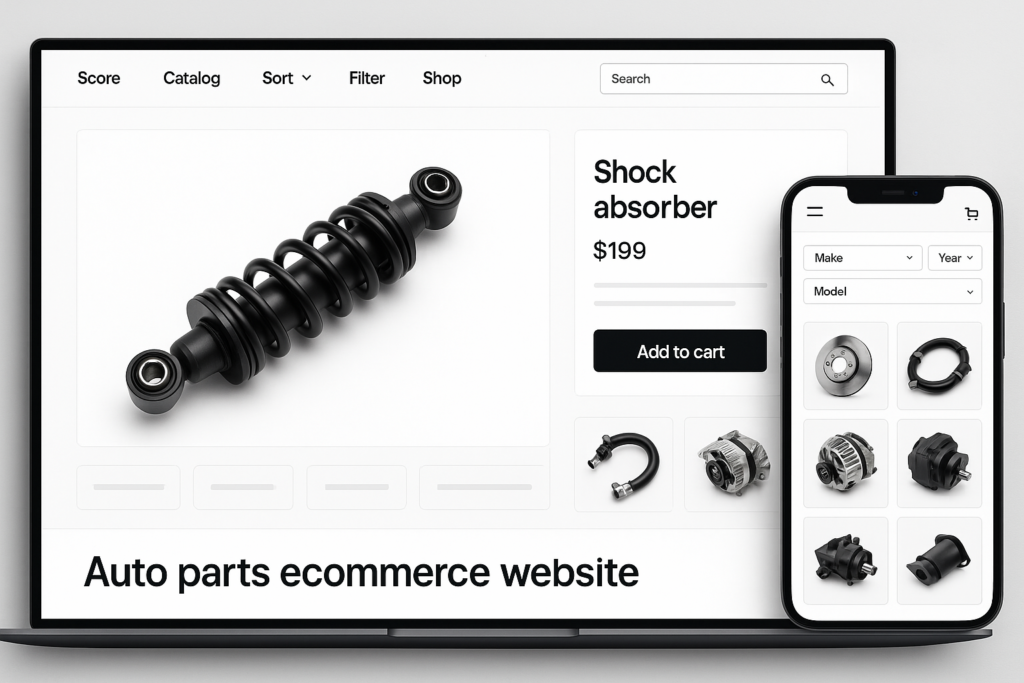
- YMM (Year, Make, Model) Selectors: Provide simple, universally accessible selectors on your homepage, category pages, and product detail pages. Buyers need to filter by vehicle in seconds.
- VIN Decoding: Integrate VIN lookup wherever possible. VIN-driven fitment tools offer unbeatable accuracy for matching parts to vehicles—vital for complex inventories or less common models.
- Compatibility Tables: Display explicit compatibility data directly on every product page. Avoid forcing shoppers to consult PDF tables or external guides; display YMM and submodel fitment in an easily scannable format with confidence markers (“Guaranteed Fit”, “Exact Match for 2018-2022 Ford F-150”).
- Vehicle Garage or Profile: Consider a “garage” feature for logged-in users, where visitors can save vehicles and instantly filter inventory sitewide.
Poor fitment UX creates a perpetual cycle of abandoned carts, customer service friction, and margin-eating returns. The most successful auto parts ecommerce stores treat fitment as the single most valuable conversion lever on their site.
Search and Filtering: How Buyers Actually Shop for Parts
The typical car parts online store fails because it relies on generic search and filtering. In auto parts ecommerce, shoppers look for parts by:
- Vehicle (year, make, model, trim)
- Category or subcategory (“brake pads”, “spark plugs”)
- OEM or interchange part numbers
- Brand or performance specification
Generic search bars and basic category trees simply can’t meet these layered, technical search needs. Performance-focused design starts with search UX:
- Multi-Attribute Filtering: Layer filters by all major automotive attributes: YMM, part type, engine type, brand, price, in-stock, and fitment status. All filters should update quickly with each selection (faceted search best practices).
- Auto-Suggest & Accuracy: Use auto-complete and auto-suggest in search bars for part numbers, vehicles, and common search phrases. Mistyped queries should deliver relevant results, not dead-ends.
- OEM and Aftermarket Data: Ingest and map OEM data sources or catalogs for VIN-linked compatibility and alternative (aftermarket) options.
All of these elements must work on mobile with the same clarity as desktop—most comparison shopping happens mid-repair, on phones. A high-performing Shopify automotive website will leverage modern search apps and data integrations, but the strategic experience layer is what differentiates winning stores.
Framework: Five-Point Audit for Automotive UX Performance
- 1. Fitment Coverage: How many SKUs/products have verified YMM, submodel, and VIN-based compatibility data?
- 2. Search Effectiveness: How quickly and accurately can a new visitor find the right part from homepage to add-to-cart—on mobile and desktop?
- 3. Filter Clarity: Are all relevant automotive filters exposed, easy to use, and fast? Are there dead-ends or “no results found” traps?
- 4. Product Data Quality: Are compatibility tables, specs, and installation info complete, readable, and free of jargon?
- 5. Trust Cues & Support: Are trust signals (return policy, reviews, warranty, live support) immediately visible pre-purchase?
Applying this lens to your existing site—either independently or through a D2C Design Free Audit—will surface the highest-impact UX wins for your auto parts ecommerce store.
Building Trust: Returns, Policies, and Conversion Triggers
Fitment accuracy and search performance convert visitors, but trust and flexibility capture first-time buyers and retention. Auto parts ecommerce sites must go further than typical DTC stores to overcome hesitation and reduce buying risk:
- Crystal-Clear Returns Policy: Returns for misfit or misordered parts are common. State up-front, in human terms, exactly how returns work, who pays shipping, and what exceptions exist for electrical or custom parts.
- Transparency on Warranties: List warranty duration and major limitations clearly in every product description. Do not bury these in generic FAQ pages or “terms” PDFs.
- High-Resolution Product Images: Use multiple views and show part labels, connectors, and included hardware. Reduce uncertainty, especially for DIY customers and small repair shops.
- Real Reviews and Ratings: Feature verified reviews and specific installation notes, including vehicle fit, install difficulty, and real buyer outcomes.
- Mobile-First UX: Fast-loading, tap-friendly interfaces are critical as buyers check parts garages, compare inventory, and place orders on-site or in their driveway.
Automotive customers who feel uncertainty at checkout convert at lower rates and are less likely to return. Our experience shows that direct, performance-focused UX upgrades—especially around data clarity and returns—can drive measurable revenue lifts. For examples of proven results in the automotive vertical, see our real results resource.
How Great Auto Parts Ecommerce Websites Drive Revenue: Three Critical Shifts
- From product-first to vehicle-first: Prioritize buying journeys that start with the customer’s car, not a generic catalog. Make it impossible to add incompatible parts to cart.
- From manual team support to automated, customer-facing fitment: Invest in tech that scales expertise—fitment tables, search UX, VIN lookup—so your team focuses on high-value support, not compatibility checks.
- From passive information to active trust-building: Don’t assume return policies, product specs, or warranty info are “known.” Push these elements into the spotlight on PDPs, cart, and checkout screens.
Final Thoughts
Your auto parts ecommerce website is only as strong as its fitment accuracy, search performance, and the trust you build before purchase. These aren’t small backend projects—they are strategic sales engines. If your current site was built on generic templates or lacks automotive-specific features, now is the time to audit what’s holding back conversion and revenue per visitor.
Ready to see exactly where your auto parts ecommerce store could improve fitment, search, and CX performance? Request a Free Audit from D2C Design and identify your highest-leverage opportunities for growth.
Common Questions
How do I set up vehicle fitment on my auto parts ecommerce website?
Fitment is achieved through YMM lookup tools, VIN decoding integrations, and robust product data management. YMM (Year, Make, Model) selectors allow customers to filter inventory for their specific vehicle, while VIN lookup provides unmatched precision. Most advanced auto parts ecommerce stores source third-party fitment data and map it directly to SKUs to maintain compatibility at scale.
What are the biggest conversion killers for automotive eCommerce sites?
Poor fitment UX creates headaches and returns, but other issues also hurt conversion: limited or confusing search/filter options, missing compatibility data, slow page speed (especially on mobile), and unclear policies around returns and warranties. Each friction point forces buyers to abandon carts or look elsewhere.
How do returns and warranties impact auto parts ecommerce revenue?
Strong, transparent return and warranty policies reduce buying anxiety—especially for DIY shoppers and small shops buying online for the first time. Clearly stated policies drive higher conversion and lower the support workload after the sale. Vague or hidden policies increase returns, weaken trust, and can create lasting negative reviews.
Can Shopify support advanced auto parts search and filtering?
Shopify can deliver robust auto parts experiences when technically optimized. With the right mix of apps, data integrations, and custom design overlays, your Shopify automotive ecommerce website can match—and even outperform—vertical SaaS platforms. For guidance on automotive Shopify architecture and proven CRO strategies, explore our Shopify services.