


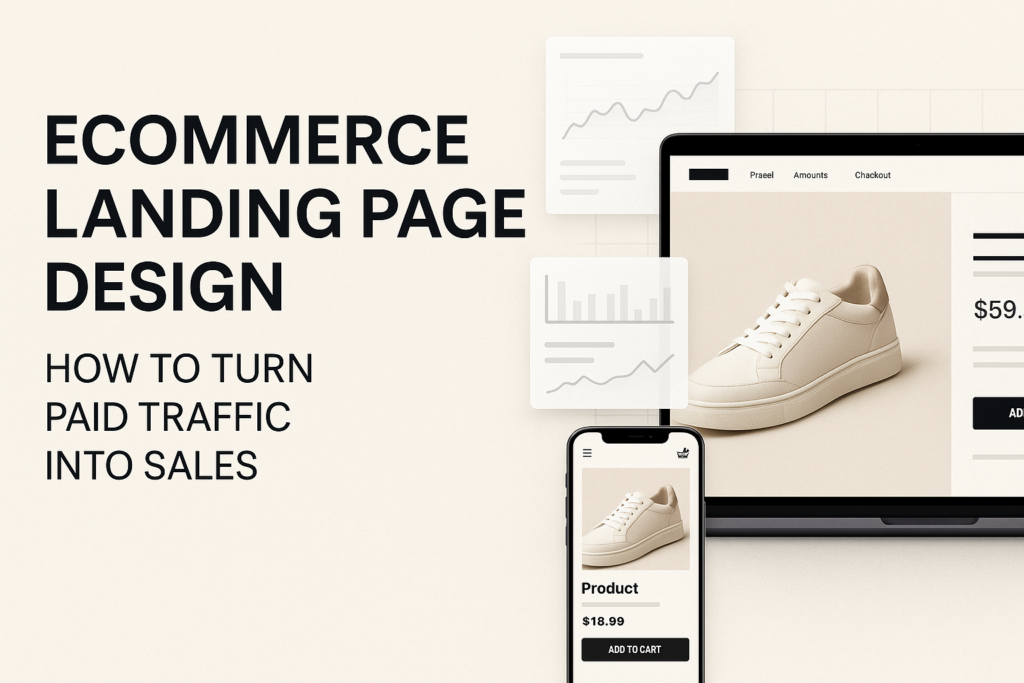
Ecommerce Landing Page Design That Converts Paid Traffic
Every ad dollar counts—yet most ecommerce landing pages fail to justify the investment. If you’re investing in paid media, but paid traffic bounces faster than you can optimize campaigns, you’re not alone. The disconnect? Most ecommerce landing page design doesn’t address what performance-minded brands actually need: clear, intentional experiences that guide visitors directly from ad click to conversion.
For ecommerce and DTC operators who rely on paid acquisition, the landing page you present is the real test of your offer. If users hit a generic product grid, slow-loading site, or a page that doesn’t match their buying intent, performance tanks. This post unpacks how product-focused landing pages increase offer clarity, buyer trust, speed, and drive measurable sales.
Why Most Ecommerce Landing Pages Fail Paid Traffic
The average ecommerce landing page fails not due to lack of creativity, but from three fundamental misalignments with paid traffic:
- Intent mismatch: Sending ad traffic to homepages or collections dilutes messaging and creates friction. Ads are specific—your landing page content needs to meet intent head-on.
- Poor performance: Slow load times or clunky mobile experience lose impatient buyers. In seconds, your site either builds confidence or pushes users to bounce.
- Lack of trust and clarity: Unclear value propositions, weak calls to action, and absent buyer assurances erode buyer momentum.
What does this look like in practice? A customer clicks your paid ad for a featured product, but lands on a general category page filled with options. The journey stalls—offer clarity is lost, decision fatigue sets in, and you pay for a click that will never convert.
The High-Converting Ecommerce Landing Page Framework
Brands that consistently win with paid traffic follow a clear, proven framework:
- Focused Content: Every landing page should be anchored to a single product or tightly-related offer. Limit distractions and navigation leaks.
- Above-the-Fold Value: Ensure the value proposition, hero imagery, and CTA are immediately visible on all devices. No scrolling needed to find the “why buy” or “add to cart.”
- Fast, Mobile-First Performance: Prioritize lean assets, compressed images, and load-speed best practices. Mobile users represent most paid traffic and are least forgiving of wait times.
- Trust Signals: Place reviews, star ratings, guarantees, and security badges clearly within the purchase path. For paid traffic (often first-time visitors), external social proof and clear return policies earn trust fast.
- Action-Driven Layout: Feature bold, uncluttered CTAs that restate the offer’s value. Make checkout or next-step actions obvious and low-friction.
Checklist for Ecommerce Landing Page Optimization:
- Does the landing page headline immediately reference the ad’s angle or offer?
- Are key product attributes and benefits crystal clear above-the-fold?
- How quickly does the page load on 4G mobile?
- Is only one central action (add to cart, buy now, get offer) available?
- Are real customer reviews included and credible?
- Are shipping, returns, and security badges visible?
- Have you removed unnecessary navigation, links, or pop-ups?
- Is analytics set up to differentiate landing-page traffic from broader site visitors?
If these fundamentals aren’t in place, landing page performance suffers. For expert support, see our Landing Page Services—built around commercial outcomes, not creative guesswork.
Key Design Elements for High-Converting Ecommerce Landing Pages
Let’s break down the specific elements proven to drive better results for ecommerce landing page design:
- Alignment of Visuals and Messaging: Your creatives, copy, and product focus should mirror the expectation set in your ad. If your ad promised a “2-for-1 bundle,” make it the hero of the page, not buried lower down.
- Speed Matters—Always: Research repeatedly shows that even one extra second of load time can drop conversion rate by double digits. Tools like Google PageSpeed Insights and Shopify’s own performance analytics help—but implementation requires experience. For Shopify brands, see our Shopify Conversion Rate Optimization approach.
- Minimal Navigation & Clear CTAs: The only exits from a high-performing landing page should be to purchase, capture a lead, or (in limited cases) learn about the core offer. Footer links, menu pulls, or unrelated product suggestions dilute paid traffic ROI.
- Multi-Device Experience: Paid campaigns increasingly drive mobile traffic—so design, test, and optimize primarily for phone screens, thumb-friendly navigation, and rapid tap targets.
- Trust and Social Proof Elements: Genuine, aggregated reviews, visible return guarantees, press logos (where genuine), and SSL security cues reassure hesitant shoppers. For new customers entering from paid, first impressions are non-negotiable.
Consistently, these details separate high converting landing pages ecommerce brands rely on from those that simply absorb traffic and inflate acquisition costs.
CRO Best Practices for Shopify and DTC Brands
Conversion rate optimization isn’t a switch—it’s an iterative, data-driven process. For Shopify landing pages and broader DTC experiences, top-performing brands integrate the following:
- A/B Testing: Test different copy, imagery, layouts, and CTA placements. Even small adjustments (headline split, trust badge color) can yield measurable lift.
- Personalized Messaging: Segment landing pages or dynamically adjust copy for different ad campaigns, traffic sources, or customer segments. Paid traffic is rarely “one size fits all.”
- Analytics and Attribution: Set up tracking pixels, UTM parameters, and post-purchase surveys. This clarity helps you know what landing pages are actually driving sales, not just collecting clicks.
- Continuous Iteration: Monthly reviews of performance metrics (bounce rate, add-to-cart, completed checkouts) should drive regular, incremental updates—not annual redesigns.
- Leverage Shopify’s Ecosystem: Use compatible apps for speed optimization, review aggregation, and checkout enhancements without overloading the site with bloat.
Not sure where to start? Our experts can pinpoint your friction points and revenue opportunities with a data-backed approach. Explore our Shopify landing page optimization services for next steps.
Final Thoughts
Landing page design matters most when stakes are highest—when every click is paid for, and every second decides if a shopper becomes a buyer. Product-focused, high-speed, trust-rich ecommerce landing pages consistently unlock greater ROI for paid campaigns. Don’t leave performance to chance: align your design to real user intent, and treat your landing pages as a core revenue-driving asset.
Ready to turn more paid clicks into revenue? Request your Free Ecommerce Landing Page Audit with D2C Design today.
Common Questions
What makes an ecommerce landing page different from a standard product or collection page?
An ecommerce landing page is specifically designed for a single campaign, product, or offer—often aligned to the messaging of a paid ad. Unlike a standard product or category page, it minimizes distractions, matches the visitor’s intent, and uses direct CTAs to maximize conversions from that particular traffic source.
How do I measure the conversion rate improvement from landing page changes?
Track traffic and transactions through analytics platforms (like Google Analytics or Shopify reports). Use unique UTM parameters for each campaign link and compare before/after conversion rates, add-to-cart rates, and average order value. A/B testing different landing page variants gives clear data on what changes drive real improvement.
What trust signals most impact buyer confidence on ecommerce landing pages?
Verified buyer reviews, visible return guarantees, SSL/security badges, and clear contact or customer service options are crucial. For new paid traffic, recognizable payment method icons and clear shipping timelines further reinforce credibility.
Why is landing page speed so important for converting paid traffic?
Paid users are often new visitors with no brand loyalty—long load times mean lost conversions and wasted ad spend. Fast pages reduce bounce rate, keep users engaged, and signal professionalism and reliability.