
Ecommerce landing page design should function as a revenue asset, not a visual add-on. We build focused Shopify landing pages for brands investing in paid acquisition, product launches, bundle offers, quizzes, lead capture, and funnel entry pages that need to convert traffic with precision.
When campaign traffic lands on the right page, CAC becomes more efficient, ROAS has room to improve, and revenue per session increases. Our work is built for brands that need high converting landing pages ecommerce teams can scale with confidence.
Request a free audit to review current traffic destinations, message match, and conversion friction across your funnel.
Most paid traffic underperforms because it is sent to pages that were never designed for campaign intent. Homepages, collection pages, and standard product templates often force visitors to do too much work before they understand the offer.
That gap between ad promise and landing experience is where performance drops. Ecommerce landing page optimization closes that gap by aligning the click, the message, and the next action.
Strong Shopify landing pages create a cleaner path:

This is a core part of effective ecommerce funnel design. Instead of dropping traffic into a broad store experience, the page is engineered to guide one audience toward one outcome.
High converting landing pages ecommerce brands rely on are not defined by appearance alone. They win because the structure supports decision-making, removes friction, and gives the visitor enough confidence to act.
Every ecommerce landing page design we build is centered on one audience, one offer, and one primary conversion goal. That focus is what separates performance pages from standard Shopify layouts.
We build Shopify landing pages for a range of campaign needs, including advertorial-style pre-sell pages, product launch pages, bundle offer pages, quiz and lead capture pages, seasonal promotion pages, and paid traffic alternatives to generic collection pages.
When landing pages are part of a broader conversion system, they work even harder. That is why many brands pair this work with Shopify conversion rate optimization to improve the full path from click to purchase.
Our process is designed to produce landing pages that are commercially useful from day one. We do not start with visuals. We start with intent, offer structure, and the role the page plays inside your funnel.
We review where visitors are coming from, what they were promised, and what mindset they arrive with. Paid social, search, influencer, email, and retargeting traffic each require different page logic.
We define the audience segment, the buying stage, and the action the page should drive. This step keeps ecommerce landing page design tied to commercial intent rather than generic site content.
We map how the page fits into your wider ecommerce funnel design. That includes pre-sell pathways, direct-to-product routes, lead capture flows, upsells, bundles, subscriptions, and post-click sequencing.
We structure the page around attention flow, proof timing, and buying momentum. The goal is to make every section earn its place.
We shape messaging around clarity, trust, and objection handling. Good ecommerce landing page optimization is often the difference between interest and action.
We build inside Shopify with performance in mind, including support for email capture, quiz tools, bundles, subscriptions, analytics, and heatmap platforms when needed.
Before launch, we validate mobile behavior, speed impact, event tracking, and page integrity across devices and traffic sources.
Launch is the starting point, not the finish line. We identify the next testing opportunities around offer framing, section order, proof placement, CTA logic, and friction points.
For ongoing insights into growth strategy and execution, you can also explore our latest articles.
Better landing pages do not just improve aesthetics. They improve the economics of acquisition. When the post-click experience is more relevant, more focused, and easier to act on, media spend works harder.
We commonly see brands use dedicated pages to support lower blended CAC through intent-matched campaigns, stronger launch performance with campaign-specific Shopify landing pages, and better paid traffic conversion without needing more traffic volume.
This is where ecommerce landing page optimization becomes operational, not theoretical. The page gives your traffic a more direct path to value, and your broader ecommerce funnel design captures more of the demand you are already paying to generate.
An ecommerce landing page is different from a product page because it is built around a single campaign objective. A product page often has to serve many traffic types at once, while a landing page is designed to match one message, one audience, and one action.
Dedicated Shopify landing pages make the most sense when traffic has a clear intent. That includes paid social campaigns, Google Ads, influencer drops, product launches, bundle promotions, and segmented email campaigns where message match matters.
One landing page should usually support one primary offer. Multiple competing paths dilute attention, weaken decision-making, and make ecommerce landing page optimization harder to execute with confidence.
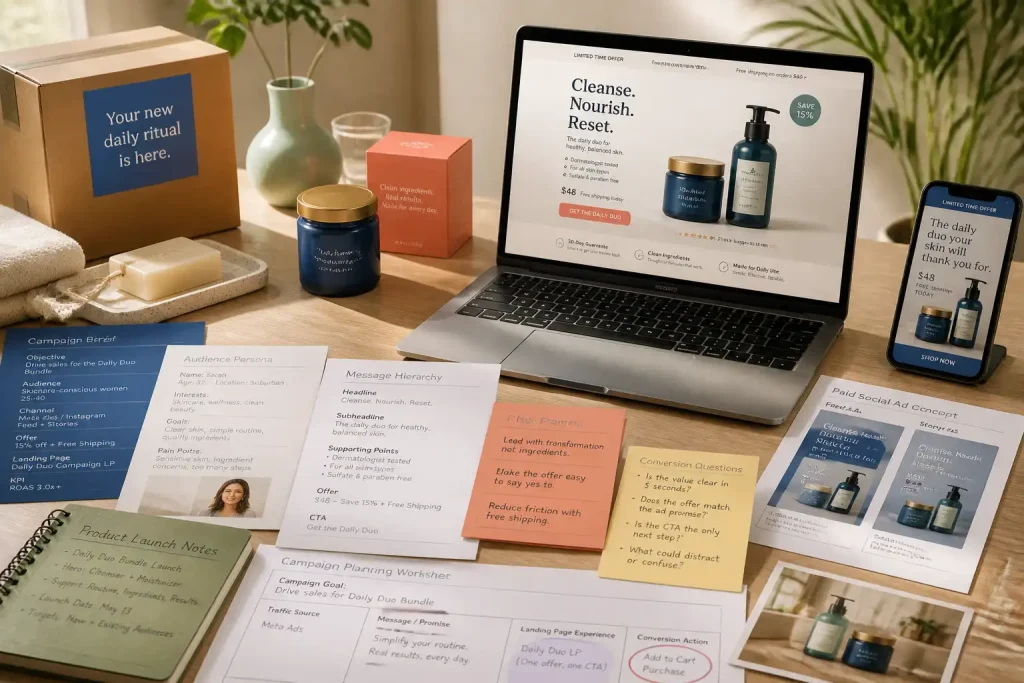
Landing pages fit into ecommerce funnel design as controlled entry points. They either move visitors directly toward purchase or qualify them into the next step through lead capture, quiz logic, pre-sell content, or segmented routing.
They also support ad efficiency. More relevant post-click experiences can improve user response, increase conversion quality, and create a stronger bridge between ad intent and onsite behavior.
If performance is inconsistent, the issue is rarely just traffic quality. In many cases, the page, the offer, or the funnel sequence is leaking demand before it has a chance to convert.
If paid traffic is landing on pages that are not built to convert, the cost shows up fast in wasted spend, weaker ROAS, and missed revenue. A focused review can identify where the disconnect is happening and what to improve first.
Our audit looks at traffic destination pages, offer-message alignment, UX friction, and the role each page plays inside your ecommerce funnel design. You will leave with clear priorities for ecommerce landing page optimization, faster wins, and the next actions most likely to improve conversion.
Get your free audit and diagnose where your ecommerce landing page design can produce stronger revenue performance.
An ecommerce landing page is a focused page built to drive a specific action from a specific traffic source. Unlike general store pages, it is designed around a clear offer, conversion path, and campaign intent.
Ecommerce landing page design is built around message match, conversion flow, and reduced distraction. A Shopify product page often needs to serve broader browsing behavior, while a landing page is optimized for a narrower, more transactional visitor journey.
Brands should use dedicated Shopify landing pages when the campaign has a defined audience, promise, or offer that generic store pages do not support well. This is especially useful for launches, bundles, paid social campaigns, Google Ads, and influencer traffic.
High converting landing pages ecommerce teams can scale usually combine strong message match, clear hierarchy, mobile-first UX, offer clarity, and well-placed proof. They also remove unnecessary choices and guide users toward one primary action.
Yes, ecommerce landing page optimization can improve ROAS by making better use of existing traffic. When bounce rate drops and conversion rate improves, media spend becomes more efficient.
Landing pages act as controlled entry points inside ecommerce funnel design. They help qualify traffic, frame the offer properly, and route users toward purchase, lead capture, or the next conversion step.
Yes, Shopify landing pages can be built with speed and performance in mind. The key is disciplined implementation, clean section structure, controlled app usage, and proper QA before launch.
Above the fold should communicate what the offer is, who it is for, why it matters, and what the visitor should do next. Strong headlines, concise supporting copy, a clear CTA, and immediate trust cues usually matter most.