
Ecommerce Email Marketing Agency: Pre-Send Fixes for Retention Revenue
Doubling down on email sends won’t fix retention—but a strategic audit will reveal exactly where revenue leaks from your lifecycle flows. For ecommerce brands, simply mailing more often is never the answer. What moves the needle is smarter strategy. If you’re evaluating an ecommerce email marketing agency or questioning your in-house results, focus first on what needs fixing under the hood before scaling up send volume. In a crowded inbox landscape, underperforming automations, ineffective content, and poor alignment with your site experience siphon profit and repeat customers every day.
Lifecycle Flow Audits—Where Most Revenue Leaks Begin
The backbone of any high-ROI ecommerce email marketing strategy is an optimized, intentional set of lifecycle flows. These are not just set-it-and-forget-it automations. Too often, brands rely on default welcome series, abandoned cart, and post-purchase emails—leaving critical customer touchpoints underdeveloped or out of sync with current merchandising strategy.
A performance-focused ecommerce email marketing agency knows that before launching more campaigns, you must:
- Audit every automated flow for conversion friction and content gaps
- Review sequence timing, offer logic, and whether emails speak to current buyer intent
- Rebuild or rewrite flows that don’t earn the next action: trusting, buying, or returning
Missed intent signals—like not personalizing content after a browse abandonment or failing to address objections in a post-purchase flow—mean lost revenue. A true partner will start here, not in the campaign calendar.
For more on how a full-funnel messaging approach powers customer journeys, visit our Marketing Communications Services.
Content, Offers, and Product Education Must Sync with Onsite Experience
Effective email marketing for ecommerce depends on trust, clarity, and continuity. When email content feels disconnected from your actual products or brand experience, the result is buyer hesitation—or worse, unsubscribes.
Brands commonly dilute their impact with:
- Generic, one-size-fits-all “10% off” offers sent to every list
- Product emails lacking education—missing storytelling, differentiation, or value proof
- Non-personalized content that doesn’t reflect current browsing or buying activity
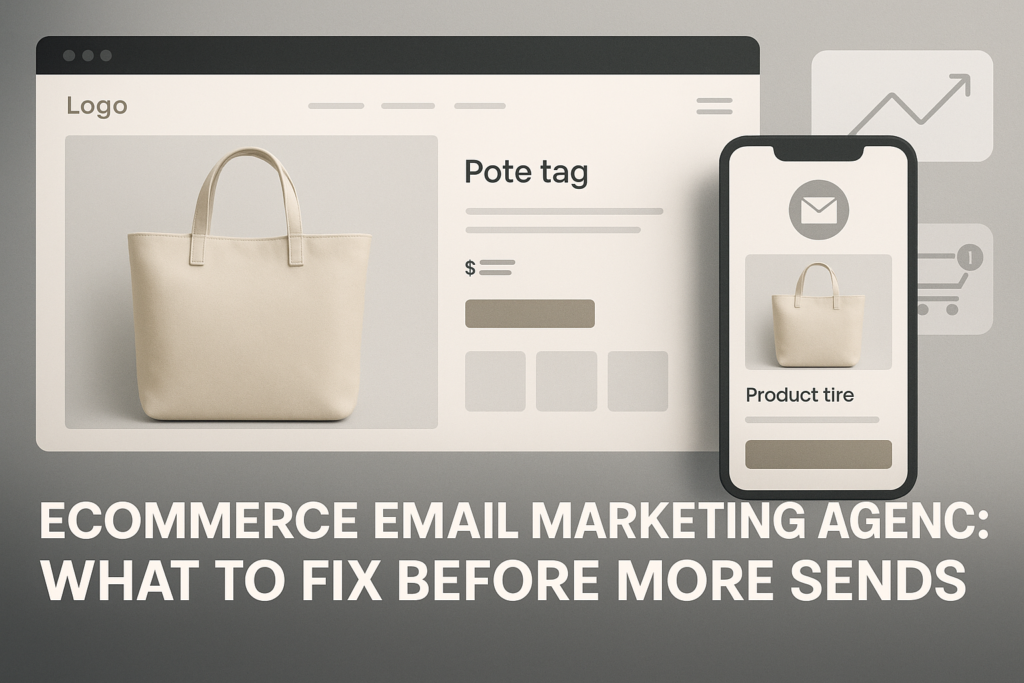
The best agencies align email strategy tightly with your Shopify website and merchandising cadence. Dynamic content, product education modules, customer stories, and FAQ snippets bring your site’s best conversion assets into the inbox. This approach increases trial, decreases confusion, and builds trust—especially for high-consideration products or crowded verticals.
Building authority through content that supports the full customer journey? Explore our Content Marketing Services.
Measuring Retention—Beyond Open Rates and Clicks
Open rates and CTR are easy to measure, but they do not reveal how well your email program drives actual revenue and brand loyalty. An experienced ecommerce email marketing agency will work from a deeper retention toolkit. Metrics that actually matter include:
- Repeat purchase rate
- Segment-specific and flow-attributed revenue
- AOV lift from loyalty or replenishment flows
- Unsubscribe trends post-promo or lifecycle changes
Vanity metrics mask performance issues. Your agency should reorient strategy around improving lifetime value (LTV), reducing churn, and maximizing retention cohorts. That means relating email performance back to both Shopify analytics and CRM data—validating not just who’s opening, but who’s buying again and why.
A Performance Audit Framework for Ecommerce Email Marketing
Before your next campaign push, apply this three-step lens to your current setup or use it to brief your next ecommerce email marketing agency:
- 1. Diagnose Lifecycle Flows: Map every trigger (welcome, abandon, browse, post-purchase). Is each driving action or simply sending?
- 2. Test Content and Offers: Does every email clearly reinforce your brand promise, reduce buyer hesitation, and advance product understanding?
- 3. Track Real Retention KPIs: Do you monitor and report repeat orders, LTV, and how specific flows or segments react—not just clicks?
Auditing these fundamentals protects your budget from wasted sends and positions every email as a revenue lever, not just background noise.
Why a Strategic Email Audit Outperforms More Sending
Most brands still try to scale email by increasing cadence or adding hastily-built automations. The result? Declining engagement and little impact on core revenue metrics. Taking a step back to audit and refine your entire ecosystem—flows, message-to-site alignment, and retention KPIs—delivers more profitable outcomes, often with less effort and list fatigue.
An audit-first approach is not just for underperforming programs. Even established brands uncover significant gains by regularly reviewing their email strategies through this performance lens. Your agency’s job is to uncover these hidden levers and build a roadmap for continuous improvement, not just maintenance.
Final Thoughts
Cutting through inbox noise starts with fixing the core of your email engine. The best performing brands—and best agency partnerships—focus relentlessly on optimizing lifecycle flows, aligning messaging with onsite experience, and measuring real retention impact. Every email should earn its place in a customer’s journey. That’s how modern ecommerce marketers convert sends into lasting revenue.
Ready to see where your biggest email revenue gains are hiding? Request a Free Audit to identify your high-impact opportunities before your next campaign sends.
Common Questions
What should I expect an ecommerce email marketing agency to audit before launching new campaigns?
An effective agency begins by auditing all core lifecycle flows, evaluating segmentation, personalization, current content, and identifying gaps in follow-up logic. They’ll prioritize fixing flows where most revenue and customer trust are lost, rather than just building more campaigns.
How do email lifecycle flows affect customer retention and revenue?
Well-crafted lifecycle flows—welcome, abandoned cart, post-purchase—guide customers toward their next best action and reinforce trust at key points. When optimized, these automations increase conversion rates, drive repeat purchases, and build long-term retention, directly impacting your bottom line.
What does “product education” in email actually look like for ecommerce?
Product education emails go beyond basic product listings to include buying guides, usage tips, FAQs, explainer videos, and customer testimonials. These help reduce hesitation and empower purchase decisions by mirroring the on-site experience in the inbox.
How do I know if my email marketing agency is focused on the right metrics for growth?
Ask your agency how they measure success. They should be tracking purchase rate, repeat customer share, segment-specific revenue attribution, and unsubscribe health—not just opens or clicks. A retention-focused agency will always push your LTV higher, not just increase short-term engagement.