

Ecommerce Website Design Agency: Building for Conversion at Every Step
Every click should move your customer closer to purchase—but most eCommerce sites still leak revenue at critical touchpoints. For growth-focused brands, it takes more than a beautiful homepage to win: your site must perform flawlessly, convert decisively, and instill buyer confidence at every interaction. An experienced ecommerce website design agency brings this focus: designing every element—from navigation to checkout—with measurable outcomes and frictionless user experience in mind.
In this article, you’ll get a clear lens into how a conversion-minded agency structures and prioritizes the pieces that matter most—so your eCommerce site isn’t leaving revenue on the table.
Why Conversion-First Web Design Outperforms the Rest
Great design should look good, but if your site doesn’t convert, visual flair alone means nothing. Too often, even major brands invest months refining brand visuals or on-trend layouts yet ignore the performance drivers that truly move the needle: navigation, product detail pages (PDPs), trust signals, merchandising, and seamless checkout. Buyers don’t care about ‘award-winning’ sites—they care about speed, clarity, and confidence through every step of their journey.
A true ecommerce web design agency grounds every choice in conversion science, not creative opinion. That means:
- Site architecture is mapped to your customers’ real behaviors—minimizing dead-end pages, distractions, and confusion.
- CTAs and page flows are tested and refined to reduce drop-off and steadily boost revenue per visitor.
- Every template, asset, and functionality is built for performance across devices and site speed metrics.
In ecommerce, design’s highest purpose is to support buying outcomes. The agencies that deliver measurable growth anchor their projects in this reality.
Essential Elements Your eCommerce Design Agency Should Engineer
No two brands are the same, but winning eCommerce sites share a pattern: they eliminate friction, build trust, and maximize merchandising. Here are the functional pillars every effective ecommerce design agency should address:
-
1. Navigation that Reduces Cognitive Load:
- Menu structures must enable shoppers to find products or information with minimal effort.
- Clear categories, relevant filters, and prominent search all play a role.
- Breadcrumbs, persistent headers, and logical sub-navigation prevent user confusion and bounce.
-
2. Product Detail Pages (PDPs) That Drive Decisions:
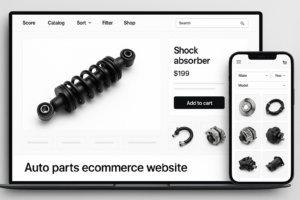
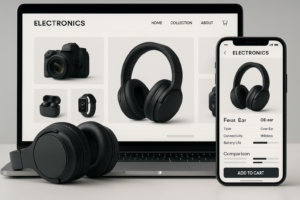
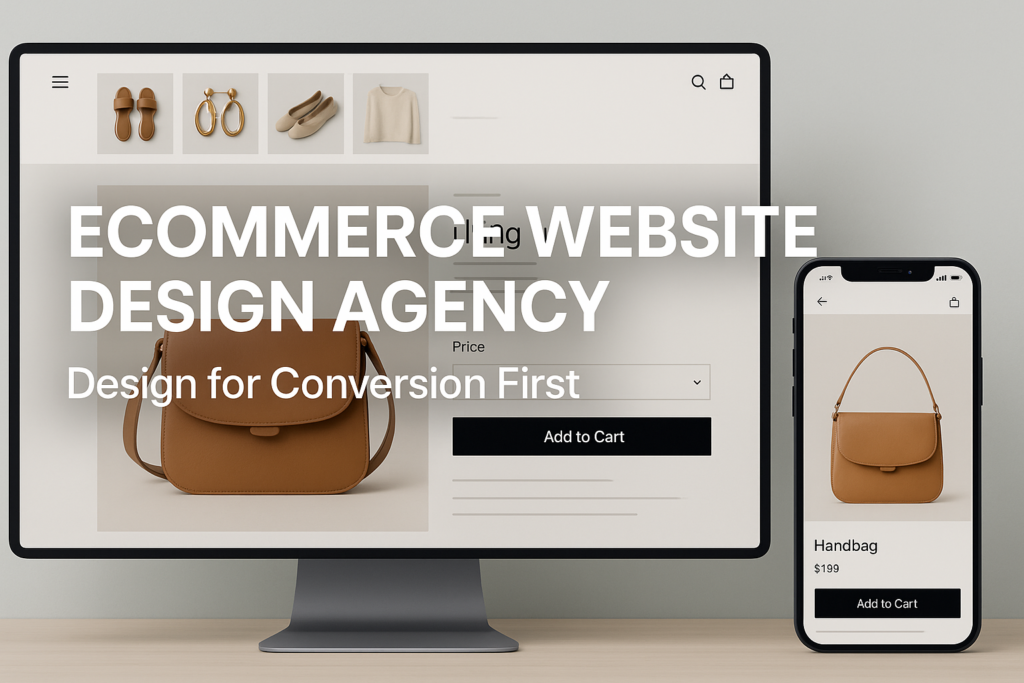
- PDPs are revenue engines. Great PDPs prioritize crisp images, persuasive copy, price transparency, and above-the-fold CTAs.
- Key selling points—guarantees, shipping, and returns—are present exactly where doubt can arise.
- Reviews, UGC, and FAQs provide the social proof today’s shoppers expect.
-
3. Trust Signals at Every Stage:
- Security badges, payment method icons, and privacy policies build confidence before checkout.
- Customer service channels should be obvious—not hidden in footers.
- Authentic testimonials and clear business info reinforce legitimacy.
-
4. Smart Merchandising:
- Strategic cross-sells and upsells based on shopper behavior, not generic recommendations.
- Landing pages and collections reflect genuine inventory and buyer intent, not internal org charts.
- Promotion banners are timely, unobtrusive, and always drive action.
-
5. Checkout Built for Zero Friction:
- Minimize fields, distractions, and loading steps.
- Progress indicators, guest checkout, and trustworthy payment processing remove barriers.
- Smart error handling—prevents cart abandonment at the final mile.
For brands on Shopify, a Shopify web design agency will optimize these elements natively for the platform—maximizing app interoperability, mobile performance, and scalable growth.
A Framework for High-Converting Ecommerce Sites
If you want your next redesign or build to be truly performance-ready, use this decision lens with your agency partnership:
- Discovery: Does every wireframe and prototype start with a real user flow review—mapping top tasks, conversion points, and drop-off moments?
- Information Architecture: Is optimization for category depth, menu logic, and on-site search a design priority—not an afterthought?
- PDP Optimization: Are layouts, feature blocks, and media assets aligned with your best sellers’ decision journeys and actual shopper objections?
- Trust and Credibility: Are you providing proof and support across every funnel stage, not just on the checkout page?
- Checkout Experience: Can a first-time buyer complete a purchase quickly, clearly, and confidently from any device, without unnecessary obstacles?
- Performance Measurement: Is every page tracked for behavior data, conversion rates, and speed—then iteratively improved?
Don’t settle for surface-level design. Use this checklist as a basis for how your ecommerce website design services should be delivered—especially if you’re investing in a site meant to scale.
Measuring What Matters: UX, Analytics, and Continuous Growth
A mature ecommerce website design agency doesn’t just launch your site and walk away. Ongoing iteration is where standout results happen. Here’s how the best agencies keep your site tuned for conversion long-term:
- User Experience Audits: Regular reviews of hot spots (and drop-off points) via analytics, session replays, and customer feedback.
- Performance KPIs: Tracking metrics like bounce rate, cart abandonment, page speed, average order value (AOV), and checkout conversion—not just traffic counts.
- CRO Experimentation: Structured split-tests (A/B and multivariate) for headlines, images, CTAs, and checkout steps to find statistically validated improvements.
- Responsive Adaptation: Monitoring device and platform trends to ensure mobile and desktop experiences aren’t degrading over time.
- Platform Optimization: For Shopify brands, this means updating themes, apps, and integrations with a focus on speed, stability, and SEO best practices.
If you’re serious about eCommerce growth, demand a partnership—not just a project. Conversion-optimized sites are always learning, always improving, and always engineered for next-level outcomes.
Final Thoughts
If your ecommerce website isn’t proactively engineered for conversion at every funnel stage, you’re competing at a disadvantage. Sustained revenue growth comes not from guesswork or aesthetics, but from rigorous design, analytics-driven iteration, and hardwired trust. In a performance economy, “pretty” isn’t enough—your site needs to work relentlessly for your business.
Want to know where your site’s real revenue opportunities lie? Request a free audit from D2C Design and get a clear map to stronger results—rooted in conversion strategy, not just creative opinion.
Common Questions
What distinguishes a conversion-focused ecommerce website design agency from a traditional web design firm?
A conversion-focused ecommerce website design agency grounds every recommendation in driving measurable business outcomes—prioritizing navigation, product pages, trust, merchandising, and checkout optimization over subjective visual design. Traditional firms might focus more on brand or aesthetics; a performance-driven ecommerce design agency is relentlessly outcome-based.
How does D2C Design structure navigation and product detail pages for higher conversions?
D2C Design uses actual user data, heatmaps, and behavior flows to architect navigation that eliminates friction and directs shoppers to high-intent pages. PDPs are designed with conversion triggers (compelling images, clear CTAs, trust cues, and objection-busting content) prioritized above-the-fold and proven through user testing—never just template-driven.
Can a site audit uncover lost revenue opportunities on my current eCommerce site?
Yes—a professional audit identifies conversion gaps, friction points, underperforming pages, and missed trust signals across your funnel. It provides actionable steps to recover lost revenue with specific, data-informed recommendations for UX, layout, and checkout optimization.
Why do trust signals and optimized checkout processes impact eCommerce growth so directly?
Shoppers are quickest to abandon sites where they lack confidence or encounter friction. Strategic trust signals (security badges, transparent returns, real testimonials) reduce anxiety, while streamlined checkout paths drive up completion rates. Both directly increase revenue, retention, and long-term brand value.