
Automotive Ecommerce Website UX: Optimizing Large Parts Catalogs for Conversion
Even the largest selection of auto parts is useless if buyers can’t find—and trust—they’ve chosen the right fit. For automotive brands scaling their ecommerce operations, poor catalog user experience (UX) results in missed sales, excess support costs, and eroded repeat business. In the automotive ecommerce industry, large and complex product catalogs aren’t just the norm—they’re the battleground. Winning buyers means building an automotive ecommerce website that balances the complexities of thousands of SKUs, vehicle fitment, and trust signals at speed and scale.
Engineering Scalable Catalog UX for Automotive Ecommerce
Large auto parts catalogs demand more than basic layouts—they require a robust catalog architecture designed for speed, precision, and actionable buyer paths. The most effective automotive ecommerce websites turn chaotic SKU sprawl into a disciplined, conversion-focused experience by:
- Building intelligent category hierarchies: Use logical, buyer-centric categories and subcategories to reduce friction. Clear distinctions like “Brakes & Rotors,” “Lighting,” and “Interior Accessories” prevent endless scrolling.
- Deploying mega menus for depth and speed: Mega menus allow users to instantly scan multiple categories or brands, minimizing back-and-forth navigation and bounce. Structure them for both quick part lookups and education.
- Streamlining product taxonomy: Align product attributes (e.g., make, model, year, fitment, performance) so customers do not face dead ends or irrelevant options. Consistent taxonomy enables smarter filters and faster discovery.
When catalog structure is treated as a conversion asset—not a technical afterthought—auto parts ecommerce stores unlock shorter paths to product, increase product discoverability, and improve retention.
Fitment, Filters, and Search: Turning Complexity Into Conversion
In automotive ecommerce design, complex fitment is both the opportunity and the challenge. Accurate vehicle-part matching, dynamic filters, and advanced search are not just features; they are conversion essentials.
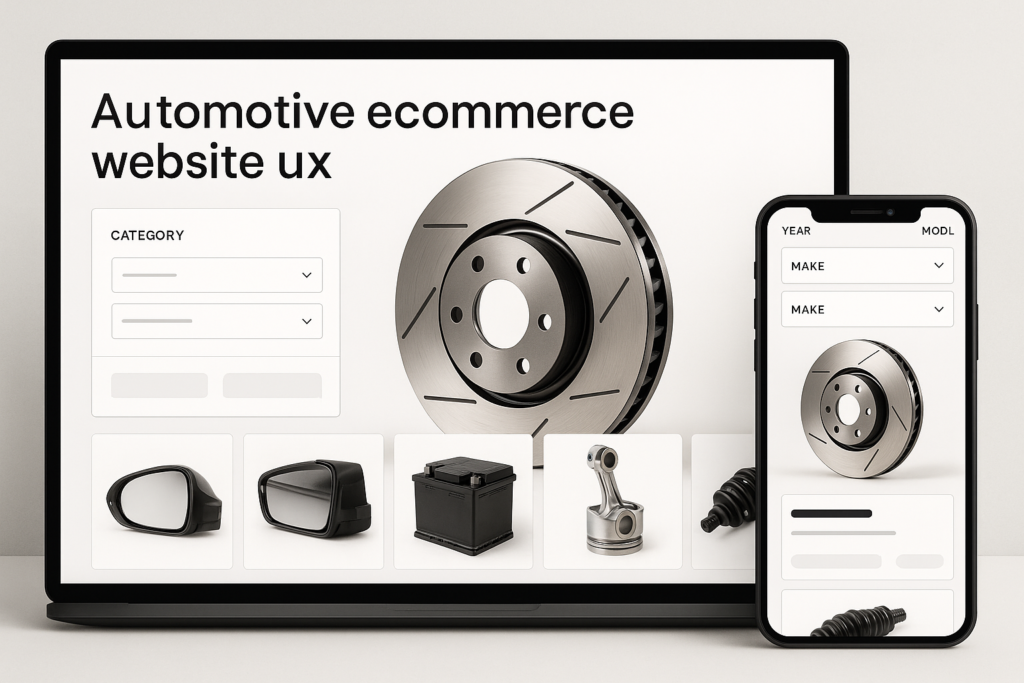
- Vehicle fitment logic: Integrate robust fitment selectors (make, model, year, trim). Buyers want certainty before clicking “Add to Cart.” Every mismatch is a lost sale or a costly return.
- Dynamic, error-proof filtering: Power filters should update in real time and reflect only compatible SKUs based on fitment, brand, price, and technical specs. Avoid filter overload—and dead ends—by grouping intelligently and removing unavailable filters.
- Precision site search: Implement autosuggest and typo tolerance for product numbers, OEM references, part types, and common synonyms. Allow quick search for both everyday buyers and professionals.
A well-architected search and filter experience is only as strong as the platforms and integrations beneath it. For high-SKU catalogs, a proven ecommerce platform like Shopify—with tailored development and catalog customization—is critical. D2C Design builds performance-first Shopify automotive stores that scale with SKU growth while remaining user-focused and fast.
A Framework: Automotive Catalog UX Fast Audit
Use this quick audit framework to evaluate your current automotive ecommerce website—or as a requirements checklist for a redesign:
- 1. Can a buyer find a part in less than 3-4 clicks from the homepage?
- 2. Does vehicle fitment (make/model/year) logic eliminate incompatible products from view?
- 3. Are product filters dynamic (only showing matches), logically grouped, and easy to clear?
- 4. Is site search fast, typo-tolerant, and suggesting relevant terms and parts numbers?
- 5. Is product data complete—especially with specs, compatibility details, and images?
- 6. Are there clear trust signals (shipping, returns, secure checkout) at every point?
Addressing these questions helps identify conversion blockers and UX gaps that directly impact revenue.
Building Trust With Data, Content, and Performance
Trust is a competitive differentiator for automotive ecommerce websites, where the risk of buying the wrong part feels high. To win and retain buyers, your store must deliver transparent, credible information at every touchpoint:
- Accurate compatibility and specs: No vague fitment data. Rich product descriptions and confirmed compatibility boost confidence and reduce support tickets and returns.
- Compelling images and rich media: High-quality, zoomable product images and 360-degree views increase conversion and decrease confusion.
- Supportive content and education: Installation guides, compatibility FAQs, and data sheets address buyer hesitations and empower faster decisions. Content isn’t decoration—it’s a conversion tool.
- Frictionless, transparent checkout: Upfront shipping options, easy return information, and secure payment messaging lower barriers to purchase, especially for high-AOV auto parts.
- Real performance wins: Automotive brands that adopt these UX and trust-building best practices consistently see repeat buyer rates rise, ticket resolution fall, and revenue per visit increase. See how results stack up in other performance-driven projects.
Trust is earned through clear, accurate data and frictionless performance—not marketing promises. In a market where buyers research exhaustively, this foundation drives conversion and repeat business.
Final Thoughts
Automotive ecommerce website success is not about how many SKUs you list—it’s about how well your site guides, qualifies, and reassures each buyer at every step. Brands treating catalog UX, fitment accuracy, and user trust as direct revenue drivers—not just design box-checks—outperform their competitors and lead their vertical. Prioritize these fundamentals, and your large product catalog becomes a growth engine, not a liability.
Ready to diagnose your auto parts store’s UX or spot new conversion wins? Request a Free Audit from D2C Design’s ecommerce specialists.
Common Questions
How does precise fitment logic improve conversion rates on an automotive ecommerce website?
When buyers know a part fits their vehicle with certainty, confidence and cart adds increase—while returns and abandoned carts drop. Accurate fitment logic builds trust, reduces support costs, and removes guesswork, all of which drive stronger conversion rates for auto parts ecommerce stores.
What are the best practices for filtering and search in an auto parts ecommerce store with thousands of SKUs?
Use real-time, dynamic filters that only show relevant options based on compatibility, and keep search fast, typo-tolerant, and supported with autosuggest. Filter groups should be intuitive, up-to-date, and easily clearable. Search should recognize both common terms and technical references.
What trust signals are most important for winning buyers on a car parts online store?
Buyers want clear compatibility data, detailed specs, quality images, prominent shipping and return policies, and secure checkout reassurance. UX and transparency, not just low prices, are what convert and win long-term customers in this vertical.
How can Shopify support high-performance automotive ecommerce design for large catalogs?
Shopify’s robust catalog management, powerful integrations, and flexible customization allow for advanced filtering, fast search, and scalable UX tailored specifically for large auto parts inventories. With expert development, Shopify’s platform supports both growth and user-centric conversion.