
Food ecommerce website design requires more than attractive visuals. It demands a buying experience built for trust, compliance, replenishment, and speed. We create Shopify experiences for food brands that need stronger conversion, cleaner product education, easier reorders, and a more scalable path to recurring revenue.
For growing brands, a high-performing food ecommerce store must reduce hesitation at every step. That means clear product detail, mobile-first decision paths, strong subscription UX, and a platform that can scale with merchandising complexity. Our Shopify services are built for operators who need performance, not generic ecommerce execution.

Food product ecommerce comes with higher trust requirements than standard retail. Customers are not just comparing price and packaging. They are evaluating ingredients, allergens, nutrition, sourcing, storage, freshness, and delivery expectations before they commit to a purchase.
That changes how a food ecommerce website design should be structured. Navigation, category logic, product pages, and checkout flows all need to help buyers make confident decisions quickly.
A food ecommerce store also depends more heavily on repeat purchase behavior. Consumable products create strong retention potential, but only when the site makes replenishment simple. For brands launching, redesigning, or scaling, that is where specialized UX starts to influence revenue directly.
A strong Shopify food website should answer key purchase questions without slowing down the journey. Buyers need to understand what the product is, why it fits their needs, and when it will arrive. The best-performing experiences make those answers visible at the moment of decision.
In food product ecommerce, trust is built through structure as much as content. We design product pages that balance storytelling with practical detail, helping customers move from interest to purchase without clutter or confusion.
and allergen details placed where buyers expect them
and brand standards integrated into product storytelling
before checkout hesitation begins
that support faster selection
that make repeat ordering frictionless
First-purchase UX and repeat-purchase UX should not be treated the same way. New visitors need reassurance and product education. Returning customers need speed, saved preferences, clear account access, and a fast path back into the basket. That distinction is central to every high-performing food ecommerce store.
Our process is built around the realities of food commerce, from regulatory nuance to catalog complexity and retention strategy. Every Shopify food website engagement starts with commercial and operational context, not surface-level design decisions.
We assess product type, customer behavior, logistics, claims sensitivity, and merchandising priorities. That includes pantry staples, snacks, beverages, specialty foods, and products that require careful communication around ingredients or regulated claims.
We map journeys for category pages, product detail pages, bundles, subscriptions, and account-level reorder flows. The goal is to make food ecommerce website design support buying behavior at every stage, from first visit to habitual reorder.
We build scalable storefront systems that handle variant complexity, merchandising needs, promotional logic, and mobile-first browsing. For brands evaluating execution quality, our real results show how conversion-led design translates into measurable commercial gains.
We create flexible product page components for ingredients, allergens, nutrition, certifications, shipping guidance, and trust messaging. These content blocks are designed to be easy to manage and clear for the customer.
Once live, we test the points that matter most to food brands: subscription uptake, bundle acceptance, average order value, checkout progression, and repeat customer rate. In food product ecommerce, growth comes from disciplined improvement, not one-time redesign work.
A stronger food ecommerce website design should produce measurable impact across acquisition, conversion, and retention. Design quality matters because it changes how quickly customers trust the product, how easily they buy, and how often they return.
For a food ecommerce store, retention economics are especially important. Consumables create ongoing demand, but weak UX often blocks that value. A better Shopify food website gives customers fewer reasons to pause and more reasons to come back.
That is why we connect every design decision to commercial performance: compliance clarity, mobile usability, product comparison, freshness messaging, merchandising depth, and reorder efficiency. The outcome is a storefront that supports growth instead of limiting it.
High-performing food product ecommerce experiences follow a clear set of requirements. They help customers evaluate quickly, trust what they see, and reorder without friction.
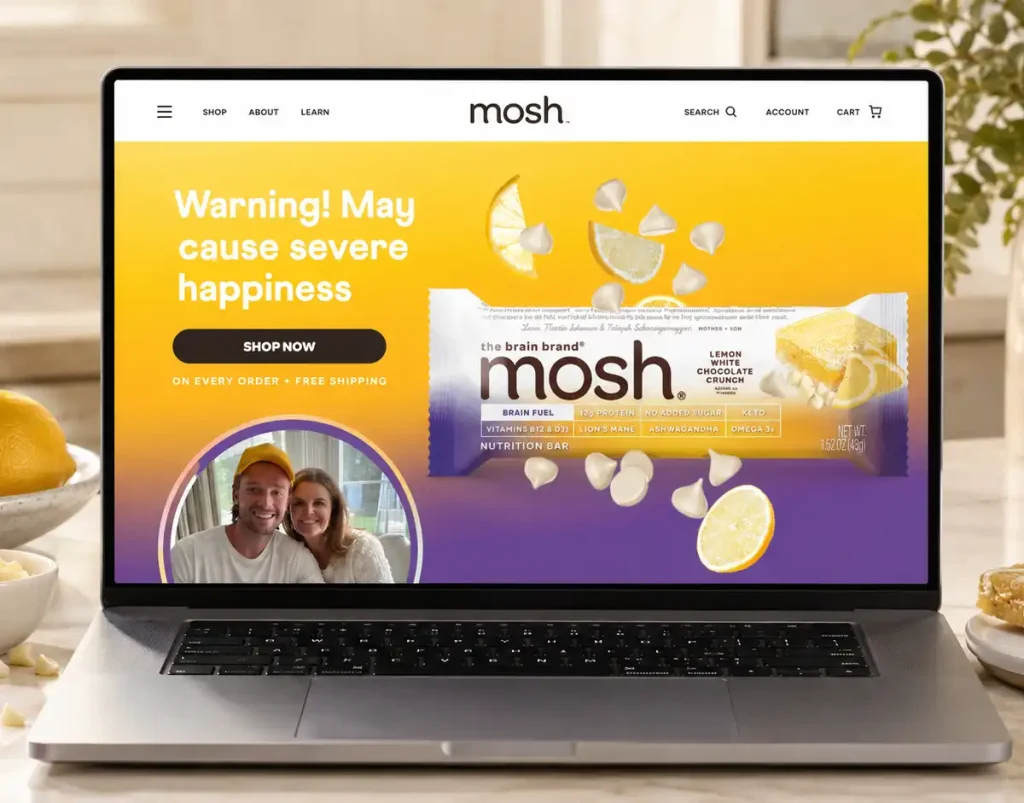
Every product page should present ingredients, allergens, nutrition facts, certifications, storage details, and shipping information in a structured format. This reduces hesitation and strengthens confidence during the decision window.
Recurring revenue should be built into the user journey, not added as an afterthought. A strong food ecommerce website design makes delivery cadence, savings, and account management easy to understand and easier to use.
Food brands can increase average order value when related products are merchandised intelligently. Variety packs, meal pairings, bulk formats, and trial bundles all need clear UX logic to support selection.
Reviews, certifications, sourcing stories, shipping clarity, and freshness messaging help reduce uncertainty. On a Shopify food website, these trust assets need to appear in context rather than being buried on secondary pages.
Shopify gives food brands the flexibility to scale merchandising, manage subscriptions, support mobile-first purchasing, and run CRO programs efficiently. For operators that need speed and stability, it remains the most practical foundation for a modern food ecommerce store.
If your current site is underperforming, the cost is rarely limited to one lost order. In food commerce, weak product pages, unclear compliance content, and underbuilt subscription flows reduce lifetime value over time.
We work with brands that need a Shopify food website built for conversion, retention, and operational clarity. If you are planning a launch, redesign, or CRO engagement, request a free audit to identify the revenue gaps in your current experience and the fastest path to improvement.
Food ecommerce website design has to handle trust and compliance demands that many other categories do not. Buyers need fast access to ingredients, allergens, nutrition details, freshness expectations, and reorder options before they purchase.
Shopify gives food brands a stable platform for scaling catalog management, subscriptions, bundles, and mobile conversion. It is especially effective for operators who need speed, flexibility, and ongoing optimization without unnecessary technical overhead.
A food product ecommerce site should clearly present ingredients, allergen disclosures, nutrition facts, storage guidance, certifications, and shipping details. These elements should be integrated into product page UX so customers can evaluate products without friction.
Strong product pages combine product education, trust signals, and clear purchase paths. We structure content so shoppers can quickly understand benefits, review ingredient and nutrition details, compare options, and add to cart with confidence.
Subscriptions work best when they are built into the product and account experience from the start. On a Shopify food website, customers should be able to understand delivery cadence, savings, skip options, and account controls without confusion.
Repeat purchase growth comes from better replenishment UX, clear account flows, reorder prompts, and subscription design. A food ecommerce store should make it easy for returning customers to buy again in as few steps as possible.
Yes, as long as the redesign is managed with proper URL mapping, metadata retention, on-page structure planning, and technical SEO controls. We approach redesigns to improve performance while protecting existing search equity.
The highest-value CRO opportunities usually include product page clarity, subscription uptake, bundle merchandising, mobile checkout flow, and reorder efficiency. For food brands, these improvements often drive gains in both conversion rate and customer lifetime value.