
An automotive ecommerce website needs more than a polished storefront. It needs fitment logic, deep catalog structure, fast search, and a buying experience built for urgency. We design and develop Shopify experiences for brands, distributors, and aftermarket sellers that need an auto parts ecommerce store customers can navigate quickly and trust at checkout.
Whether you run a growing car parts online store or a complex multi-brand catalog, we build around the realities of automotive buying behavior. That means scalable product architecture, conversion-focused UX, and a technical foundation that supports growth without creating operational drag.
Request a free audit to review your catalog structure, filtering requirements, and Shopify implementation path.
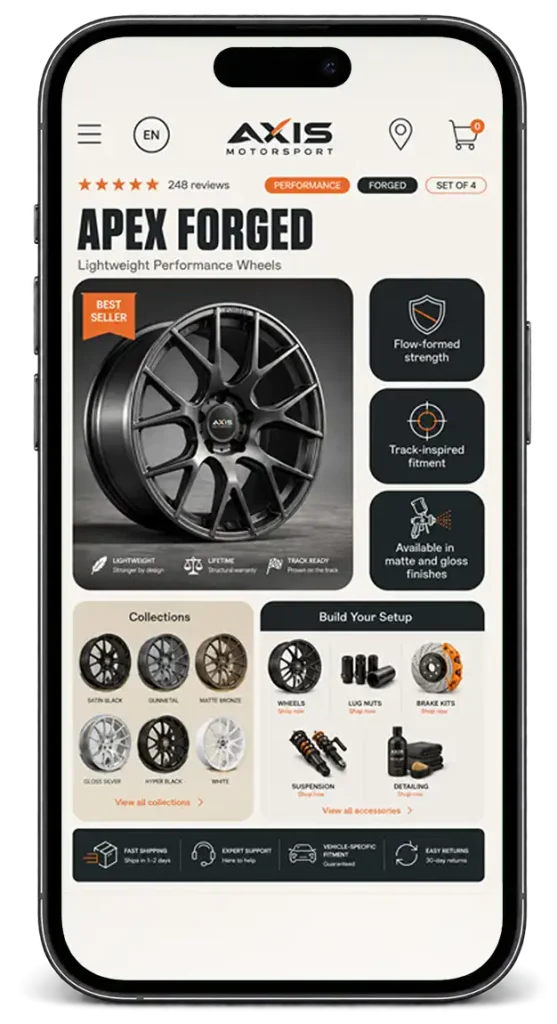
Automotive buyers rarely shop like standard retail customers. They search by vehicle compatibility, part type, SKU, brand, performance use case, and delivery urgency. A generic storefront creates friction at every step.
A high-performing automotive ecommerce website must help users find the right part fast, confirm fitment clearly, and purchase with confidence. When that experience breaks down, conversion suffers and support costs rise.
The strongest automotive ecommerce website combines technical precision with a fast buying flow. Product discovery needs to work across broad categories, narrow vehicle matches, and high-intent searches from mobile and desktop users alike.
We build automotive stores around the capabilities that directly affect conversion and average order value.
An effective auto parts ecommerce store also needs landing pages that support both browsing and demand capture. Brand pages, part-type collections, and application-specific routes can all drive qualified traffic when they are mapped to real search behavior.
that supports brand, part type, application, and fitment paths
for year, make, model, category, brand, and key attributes
that surfaces relevant products before users bounce
built to support faceted navigation and merchandising control
that make compatibility, specs, and purchase decisions clear
that keeps search, filters, and add-to-cart actions friction-free
designed to protect conversion under urgency
This is why we treat a car parts online store as a performance channel, not a visual redesign. Structure, filtering, and merchandising determine how much revenue your catalog can actually produce.
Our delivery process is tailored to automotive complexity. We start with product data, buying paths, and compatibility requirements before design decisions are made. That gives the automotive ecommerce website a stable operational foundation from day one.
We define how products, variants, fitment attributes, brands, and application data should be organized. This includes metafields, taxonomy logic, and bulk-friendly models that support a growing auto parts ecommerce store.
We map year, make, model and other relevant compatibility layers into the storefront experience. The goal is simple: reduce uncertainty and make the right part easier to buy
We structure categories, subcategories, landing pages, and filters around how customers actually search. This creates clearer pathways for both browse-based and direct-intent users in a large car parts online store.
We configure advanced filtering, search tooling, and merchandising rules that support high-SKU catalogs. Users should be able to narrow fast without losing context or landing in dead-end collection pages.
We design product pages to surface fitment, technical specifications, shipping information, and purchase confidence signals in the right order. That reduces hesitation and lowers support dependency.
We build on Shopify with scalability in mind, including app configuration, custom theme components, and readiness for ERP, PIM, inventory, and operational integrations. Learn more about our Shopify development services for brands that need a more capable build.
Before launch, we validate performance across navigation flows, product discovery, mobile behavior, and checkout paths. Every automotive ecommerce website should be tested against real buying scenarios, not just visual review.
When structure improves, revenue signals follow. Better discovery, cleaner compatibility messaging, and stronger merchandising all affect how quickly users move from search to checkout.
A well-executed auto parts ecommerce store also performs better operationally. Clean taxonomy, reusable templates, and scalable collection logic make it easier to launch new inventory, manage promotions, and support repeat buyers over time.
Our work is measured by performance, not appearance alone. You can review real ecommerce results from brands that needed stronger conversion and more reliable growth infrastructure.
An automotive ecommerce website differs from standard ecommerce because product eligibility matters as much as product appeal. The platform must support compatibility-driven discovery, detailed product data, and flexible catalog management at scale.
Filtering improves conversion because it reduces decision friction. In a large auto parts ecommerce store, users need to move from broad search to exact-match products quickly, especially on mobile where patience is limited.
Fitment data matters because it protects both conversion and margin. When the wrong part is ordered, the cost is not only a return. It also creates support overhead, lost trust, and lower repeat purchase rates.
A car parts online store needs several capabilities to scale effectively:
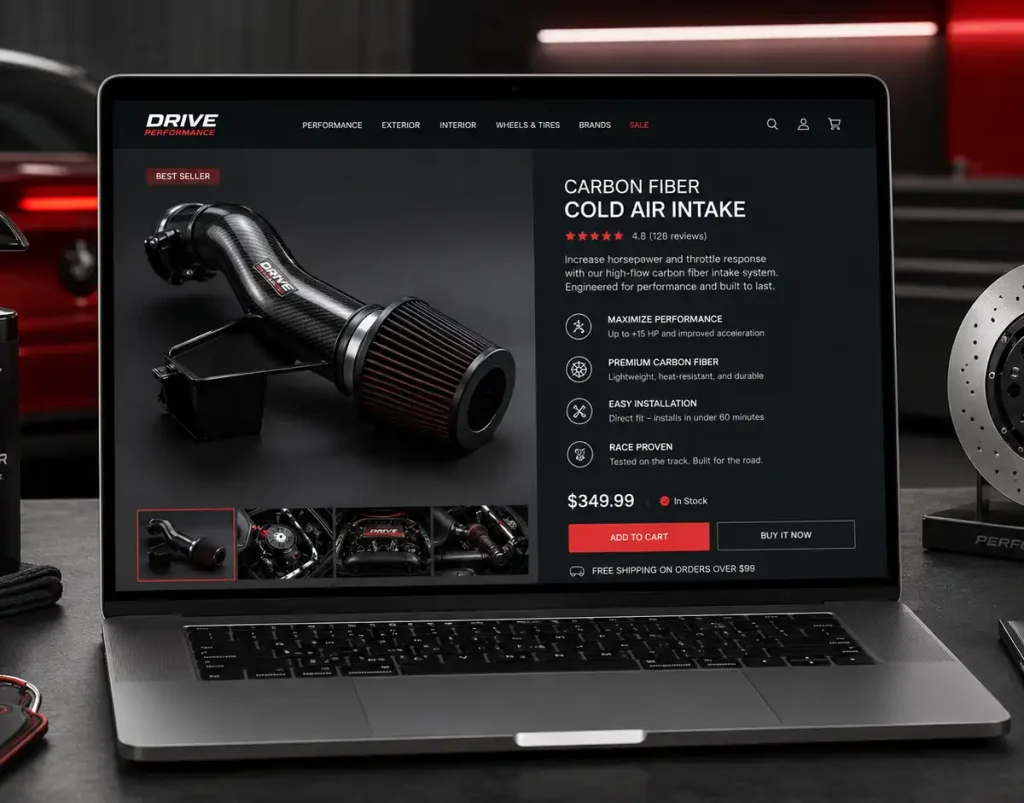
Structured product data with custom attributes and metafields
Faceted navigation across category and compatibility layers
Search experiences tuned for SKU, brand, and application queries
Collection logic that can expand without creating duplication
Templates that clearly separate universal parts from vehicle-specific products
Operational flexibility for inventory, ERP, and product information workflows
Shopify works well for automotive brands when the build is planned correctly. With the right data model, theme strategy, and integration layer, it can support a high-volume automotive ecommerce website without compromising usability or maintainability.
If your catalog is growing, your storefront needs to do more than display products. It needs to guide selection, reduce errors, and convert demand efficiently. That is exactly where a specialized automotive ecommerce website creates measurable advantage.
We work with automotive teams that need a stronger auto parts ecommerce store architecture, cleaner fitment logic, and a Shopify build prepared for scale. The next step is a technical review of your catalog, filters, user flow, and platform setup.
Get your free audit and we’ll assess where your current automotive ecommerce website is creating friction, where conversion is being lost, and how to improve the buying experience for a high-SKU car parts online store.
An automotive ecommerce website should include fitment logic, advanced filtering, predictive search, strong category structure, and product pages with clear compatibility details. It also needs mobile usability, fast load times, and scalable product data management.
Yes, Shopify can support a large auto parts ecommerce store when the catalog is structured correctly and the right data model is in place. The key is planning taxonomy, metafields, filtering, and integration requirements before development begins.
We build filtering by structuring compatibility and product attributes into organized data fields that can power storefront logic. This allows the automotive ecommerce website to narrow results accurately and present users with relevant parts faster.
A car parts online store should be organized around how customers search, including vehicle, category, brand, and application pathways. Clear collection hierarchy, faceted navigation, and compatibility visibility are critical to reducing friction.
Wrong-part orders are reduced by making fitment validation and compatibility messaging clear throughout the buying journey. Product templates, filters, and search results should all reinforce whether a part matches the intended vehicle or use case.
Yes, Shopify can support fitment data and custom attributes through metafields, custom data structures, and app or integration layers when needed. This makes it viable for many automotive ecommerce website builds with specialized catalog requirements.
Timelines depend on catalog complexity, fitment requirements, design scope, and integrations. A focused auto parts ecommerce store project typically moves faster when product data is clean and decision-making is aligned early.
Important integrations often include ERP, PIM, inventory systems, search and filtering tools, review platforms, and shipping or fulfillment software. The right stack depends on how the automotive ecommerce website is managed internally and how complex the catalog is.