
A high-performing home goods ecommerce website needs more than attractive design. It needs a structure that helps shoppers move through large assortments, compare options quickly, and find the right products without friction. We build conversion-focused Shopify experiences for home brands that need stronger navigation, cleaner merchandising, better mobile usability, and measurable revenue growth.
From a multi-category home decor ecommerce website to a complex Shopify home goods store with layered collections and variant-heavy products, we design around how customers actually shop. The result is a storefront built for discovery, clarity, and conversion.
Request a free audit to identify the structural, UX, and performance issues holding your store back.
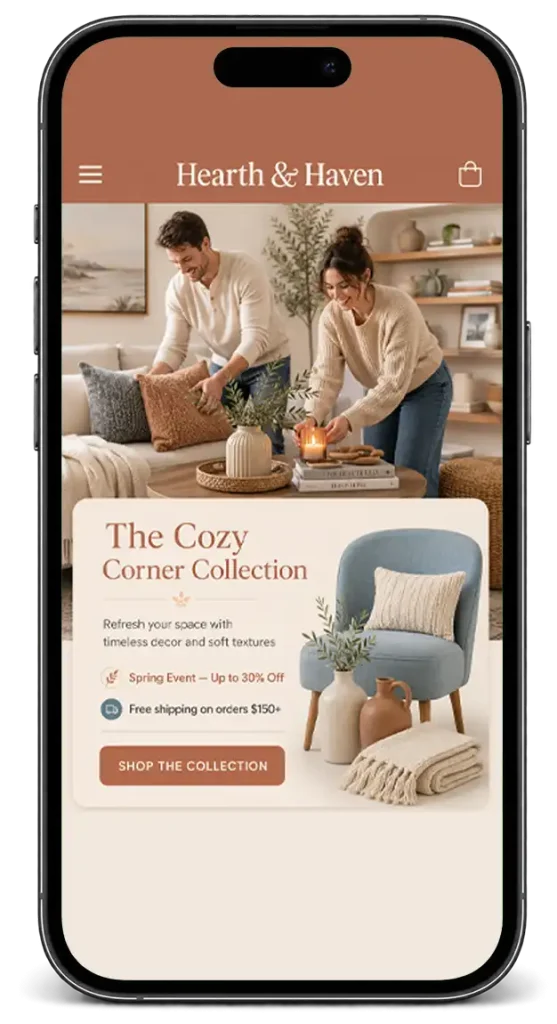
Home goods shoppers do not browse like standard retail buyers. They shop by room, style, size, finish, material, use case, and price point, often across overlapping categories. That makes the architecture of a home goods ecommerce website a conversion decision, not a design detail.
For a furniture ecommerce store or a home decor ecommerce website, poor structure creates hesitation fast. Shoppers get lost in broad collections, duplicate pathways, unclear filters, and inconsistent product grouping. That friction increases exit rate and reduces product discovery.
We solve that by building systems that make large catalogs easier to navigate and easier to buy from. Our Shopify design and development services are built for brands that need catalog clarity, merchandising control, and stronger conversion performance at scale.
Product discovery is one of the biggest revenue levers in a Shopify home goods store. When navigation, filtering, and collection design are built correctly, shoppers view more products, engage more deeply, and reach purchase decisions faster.
We design UX systems specifically for home brands, where visual browsing, comparison behavior, and collection overlap are more complex than a typical ecommerce build. That matters whether you run a home decor ecommerce website with seasonal merchandising needs or a furniture ecommerce store with large product families and multiple variants.
that support category depth without overwhelming the user
with strong visual hierarchy and fast scanning
aligned to material, dimensions, style, color, price, and availability
that helps users refine intent without dead ends
for faster comparison and lower browsing friction
for new arrivals, best sellers, low stock, and promotions
to surface complementary products
designed for thumb-first navigation
Every UX decision is tied to commercial outcomes: more collection interaction, stronger add-to-cart rates, lower bounce, and better average order value.
Our process combines strategy, UX, design, and technical execution. A high-performing home goods ecommerce website is not created through visuals alone. It requires a disciplined build that aligns taxonomy, templates, merchandising controls, and performance.
We define the taxonomy that shapes how users browse your inventory. This includes collection logic, category relationships, tagging standards, filter structure, and room-based or style-based pathways.
We map the shopper journey across collection pages, search, product templates, cart flows, and mobile interactions. The goal is to reduce friction and improve product visibility across the full catalog.
We create scalable interface components for a Shopify home goods store, giving your team consistency across collections, merchandising blocks, product cards, and content modules.
We build templates that support broad assortments, rich imagery, variant logic, delivery details, dimensional information, and related product merchandising. This is especially important for any furniture ecommerce store with complex product page requirements.
We improve search relevance, faceted navigation, and filter usability so shoppers can narrow large inventories quickly and confidently
We test real user flows across devices to ensure your home goods ecommerce website performs under image-heavy, mobile-first shopping conditions.
If your current store has strong products but weak discovery, explore our recent client results to see how structural improvements translate into commercial gains.
When the architecture is right, the metrics move. We build each home goods ecommerce website to improve the signals that matter most: conversion rate, search engagement, collection page interaction, revenue per visitor, and average order value.
This is especially important for a furniture ecommerce store or large Shopify home goods store managing extensive SKU counts, rich product media, and high mobile traffic. Scale introduces complexity. The build has to absorb that complexity without slowing the user down.
We focus on Shopify performance optimization from the start, so the storefront remains fast, stable, and commercially effective as your catalog expands.
The strongest navigation model for a home decor ecommerce website balances breadth with clarity. Shoppers need multiple ways to browse, including room, category, style, material, and price, without creating duplicate or confusing paths.
Filters directly influence product discovery in a furniture ecommerce store. Well-structured filters reduce decision fatigue, shorten time to product, and help users navigate broad assortments with confidence.

Product pages for home brands need more than imagery. They should include dimensions, materials, finishes, care guidance, delivery details, variant clarity, and related product merchandising that supports the buying decision.
Shopify works well for a Shopify home goods store because it combines flexible merchandising, scalable template development, app ecosystem support, and strong operational reliability. With the right implementation, it supports both catalog complexity and growth.
Mobile UX has a direct effect on conversion for any home goods ecommerce website. Fast load times, compact filtering, sticky conversion elements, and friction-free navigation improve product viewing, cart progression, and completed orders.
If your brand is dealing with complex collections, underperforming category pages, weak mobile conversion, or limited merchandising control, the solution is not incremental design changes. It is a better system.
We design and develop every home goods ecommerce website around better navigation, better discovery, and better conversion. Whether you need a full rebuild or targeted optimization of an existing Shopify home goods store, we can identify the changes that will have the biggest commercial impact.
Book your free audit and get a direct view of the UX, structure, and Shopify opportunities inside your store.
A strong home goods ecommerce website needs clear navigation, effective filters, fast mobile UX, and product pages built for comparison and confidence. It should also support large catalogs, strong merchandising, and efficient product discovery across collections.
We structure a home decor ecommerce website around how people actually browse, including room, category, style, function, and price. The goal is to reduce overlap, improve findability, and create cleaner paths from entry to product page.
Yes, Shopify is a strong platform for both home goods and furniture brands when the store is architected correctly. A well-built Shopify home goods store can handle broad assortments, custom merchandising, scalable templates, and strong performance.
Filters and search help shoppers narrow large product sets quickly, which reduces friction and increases product engagement. For a furniture ecommerce store, that often leads to more product views, stronger add-to-cart rates, and lower bounce.
Effective product pages combine strong imagery with practical buying details such as dimensions, materials, finishes, delivery information, and variant clarity. For a home decor ecommerce website, related products and room-based merchandising also help increase order value.
Yes, we regularly improve existing storefronts without requiring a full rebuild. For many brands, targeted UX, navigation, collection, and template changes inside a Shopify home goods store can unlock significant performance gains.
We solve this through taxonomy planning, filter logic, scalable templates, and clear merchandising rules. That approach keeps a home goods ecommerce website usable even when the catalog is broad, deep, and operationally complex.
The biggest gains usually come from better collection design, cleaner mobile navigation, stronger filtering, faster load performance, and more effective product page architecture. These improvements help users find products faster and complete purchases with less friction.