
Fashion Ecommerce Website Design: Faster Product Discovery That Converts
Every second shoppers spend hunting for the right product is a lost sale. In the world of fashion ecommerce website design, speed and clarity aren’t just nice-to-have—they are central to higher conversion and stronger business performance. If your apparel ecommerce site is putting up unnecessary roadblocks, your visitors won’t wait around. They’ll leave for a competitor whose website is designed for faster product discovery and effortless shopping experiences.
Fashion and apparel brands operate in one of the most competitive ecommerce categories. Shoppers expect instant results, intuitive navigation, accurate sizing, and seamless mobile experiences. Unless your site is purpose-built for these demands, you’re leaving opportunity, revenue, and growth on the table.
Accelerating Product Discovery on Fashion Ecommerce Sites
Fast-moving fashion brands win by removing friction from the exploration and shopping journey. Effective fashion ecommerce website design doesn’t just look good; it enables shoppers to find, filter, and buy the right products with minimal effort. Here’s what high-performing brands get right:
- Collection Hierarchies that Match Shopper Intent: Organize your catalog by audience-relevant categories—by season, style, fit, trend, or collection. Avoid overwhelming visitors with vague or redundant options.
- Prominent and Predictable Navigation: Shoppers must reach any major category within one or two clicks. Navigation should be visible, logical, and tested for usability on all devices.
- Smart Merchandising Placement: Feature new arrivals, bestsellers, or time-sensitive collections upfront in your menus or home page. Strategic merchandising speeds up decision-making and elevates the perceived value of star products.
For fashion brands using Shopify, leveraging built-in collection management and liquid templates allows for agile changes, but the difference maker is custom design strategy. Explore how Shopify web design services from D2C Design unlock these advantages.
The Fashion Ecommerce Product Discovery Checklist
- Every top-level collection is visible on desktop and mobile navigation.
- Filters include size, color, price, and ‘new in’ as a minimum.
- Mobile search and filtering require no more than one tap from any landing page.
- Ranking or sorting options are available and easy to find.
- Homepage and major collections are merchandised with relevant, up-to-date products.
PDPs, Sizing, and Merchandising That Convert
The product detail page (PDP) is the pivotal conversion lever in any clothing ecommerce store. Unfortunately, it’s also where most fashion ecommerce websites lose momentum—especially when shoppers face uncertainty about sizing, fit, or color accuracy.
What makes PDPs high-converting in apparel ecommerce?
- Detailed, Dynamic Sizing Guides: Beyond static size charts, use interactive guides that help shoppers compare fit, model measurements, or even crowd-sourced fit feedback. Sizing uncertainty is a top killer of conversion (and a driver of costly returns).
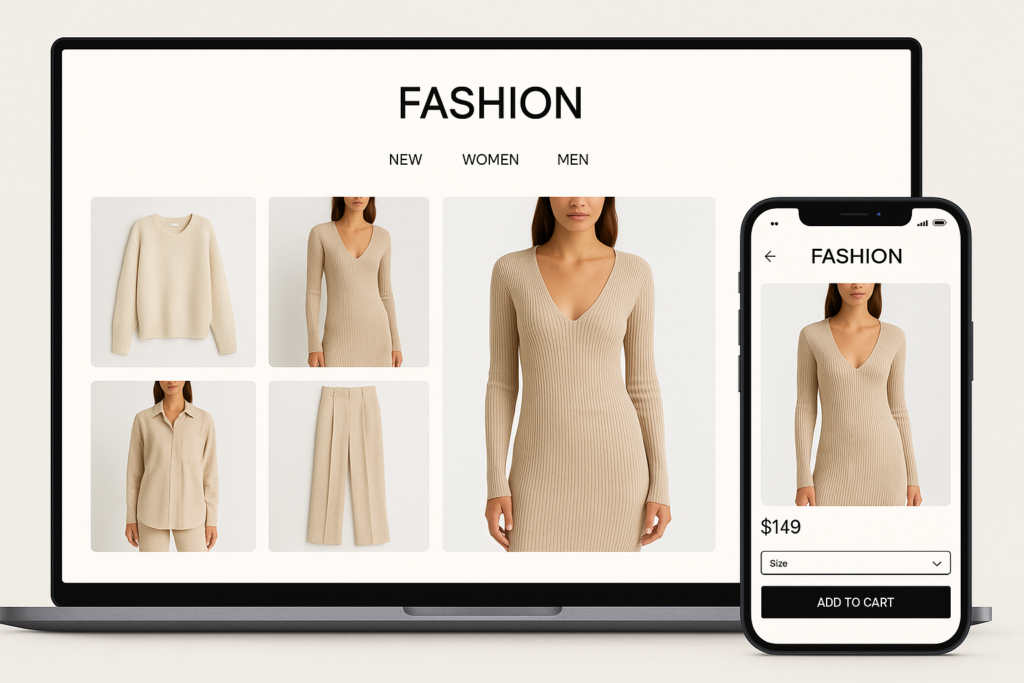
- Clear, High-Quality Imagery: Offer product images from multiple angles, include zoom, and show on-model shots for every major color or size. Some leading shopify fashion brand websites use short videos, 360° views, or augmented reality.
- Concise, Merchandising-Driven Copy: Bullet benefits, clear fabric details, care instructions, and notable style points. Prioritize what moves a browser to a confident purchase.
- Short, Distraction-Free Path to Checkout: Minimize clutter and secondary CTAs. Ensure add-to-cart and buy buttons are above the fold on all screens.
Top-performing fashion ecommerce sites continually audit PDPs for usability. They use A/B testing or heatmaps to remove hesitation points and streamline the journey from interest to purchase. Real results show that even minor PDP UX adjustments can produce major uplifts in conversion rate.
Mobile Usability and Advanced Filtering
Mobile now accounts for the overwhelming majority of apparel ecommerce traffic. If your fashion ecommerce website design isn’t optimized for mobile speed and filtering, you’re missing a significant share of ready-to-buy shoppers.
- Mobile-First Navigation: Hamburger menus, expandable filters, and thumb-friendly controls are essential. Ensure every filter and major collection is accessible within a single tap from the home or landing page.
- Layered and Contextual Filtering: Allow shoppers to combine multiple filters (size + color + price) without slow reloads or broken sorts. Filters should update asynchronously for lightning-fast results.
- Performance-Focused Design: Compress images, leverage lazy-loading, and audit third-party scripts that slow load speeds. Mobile shoppers expect pages to load in under two seconds—any delay causes drop-off.
For Shopify fashion brand websites, advanced filtering often requires custom development or vetted third-party apps, but the ROI is clear: less friction, more conversions. Learn how D2C Design delivers performance-optimized Shopify sites for fashion and apparel.
Continuous UX Audits: The Overlooked Performance Driver
Most clothing ecommerce store owners perform a major redesign only once every 2-3 years. But in today’s fast-evolving customer landscape, that passive approach leaves significant revenue untapped. High-performing apparel ecommerce brands adopt a rhythm of regular site audits, performance benchmarking, and iterative UX improvements.
What should a conversion audit include?
- Analysis of click and navigation data to spot drop-off points
- Usability testing on PDPs, filtering, and checkout
- Review of return and support tickets for UX friction signals
- Mobile speed and accessibility audits
- Competitor and adjacent-industry benchmarking
Brands that implement these learnings—and adapt their fashion ecommerce website design accordingly—see compound gains in conversion, average order value, and long-term retention. See our proven approach to continuous improvement and conversion strategy for fashion ecommerce clients.
Final Thoughts
Fashion ecommerce success isn’t about chasing the latest design trend or launching a new theme every year. It comes from making smarter, ongoing improvements—especially in how quickly and confidently your customers can find and purchase their next favorite piece. Small, data-driven UX investments yield exponential business returns in the fashion vertical. Don’t underestimate the impact an optimized discovery journey can make at every level of your funnel.
Curious which UX or discovery improvements should be next for your clothing ecommerce store? Book your Free Audit with D2C Design and get a tailored action plan for revenue growth, higher conversion, and a competitive fashion ecommerce website design.
Common Questions
What makes fashion ecommerce website design unique compared to other industries?
Fashion ecommerce requires faster, more visual product discovery, support for wide arrays of sizes and styles, and precise merchandising by trend, season, and buyer persona. Unlike commodity or niche ecommerce stores, clothing and apparel sites must solve for frequent catalog refreshes, high return rates, and demanding mobile shoppers.
How can I improve product discovery and filtering on my apparel ecommerce site?
Focus on a clear collection hierarchy, intuitive multi-criteria filtering (size, color, style, price), and mobile-first navigation. Make every major collection and filter instantly accessible, and ensure site speed is never a barrier between the shopper and their desired products.
What are best practices for PDPs and sizing guides in a clothing ecommerce store?
Use clear, interactive sizing guides, on-model photography, and concise product benefits. Your PDPs should eliminate doubts about fit and styling, provide quick add-to-cart options, and offer trust signals (such as reviews or buyer photos) for social validation.
How do I know if my fashion ecommerce site is losing sales due to poor UX?
Look for high drop-off rates on category or PDP pages, low mobile conversion, repeated customer questions about sizing or navigation, or high product return rates. A UX and conversion audit will pinpoint specific friction points costing your site revenue and growth.